
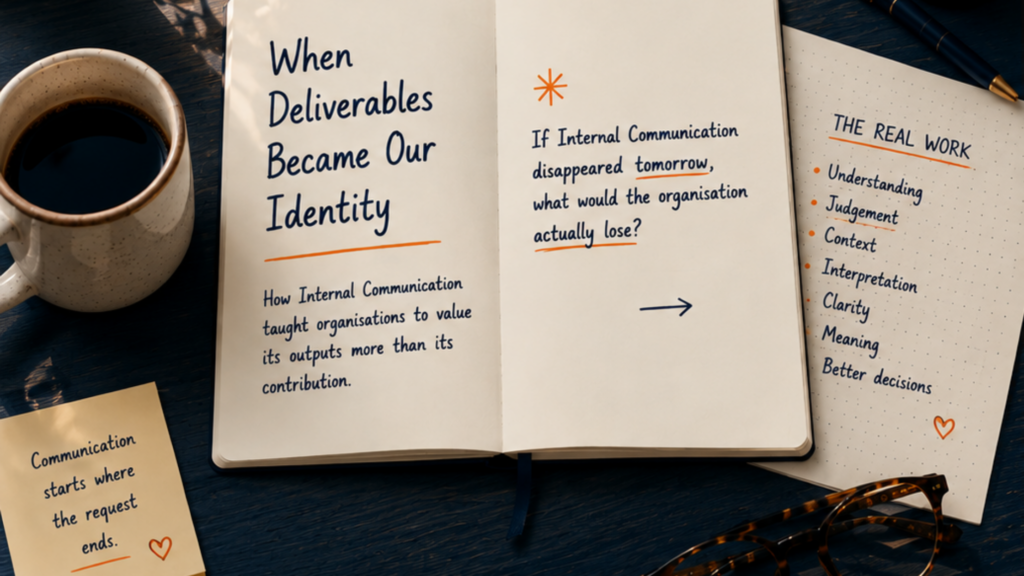
When Deliverables Became Our Identity
- trinimaturana
- Reflexiones y Opinión, The Voices in English
Índice
How Internal Communication taught organisations to value its outputs more than its contribution.
At some point during my time building internal communication at SimpliRoute, I stopped and asked myself a question I had been avoiding.
If this function disappeared tomorrow, what would the organisation actually lose?
Not the newsletter. Not the town hall. Not the cascade deck. What would it lose that it could not replace with something faster, cheaper, or increasingly, automated?
The question was uncomfortable. It still is. And I have come to believe that the discomfort itself is the most honest thing our profession has produced in years.
The answer we trained organisations to expect
When someone asks what Internal Communication does, the answer comes quickly and almost automatically.
We manage the intranet. We run campaigns. We support leaders with key messages. We coordinate channels. We produce content.
We have become extraordinarily fluent at describing ourselves through the things we make. And somewhere along the way, that fluency became a trap.
Dominic Walters, President of the IoIC and someone who has been watching this profession evolve for more than three decades, named it with unusual clarity when we spoke. Communicators, he said, would often describe their work through channels and methods when sitting in front of senior leaders, and in doing so would reinforce exactly what those leaders already suspected: that Internal Communication was primarily a technical function rather than a strategic one.
The irony is that we never intended to position ourselves that way. Deliverables were visible. They could be counted, reported and celebrated. They fit neatly into quarterly updates. The most valuable parts of our work, the conversation that helped a leader understand why a transformation was losing credibility, the tension spotted before it appeared in an engagement survey, the reframe that changed how a decision landed, left almost no trace. So we talked about what we could show. And organisations learned to evaluate us by exactly that.
We did not just define our work through deliverables. We taught organisations to mistake them for our value.
What the people building real change told me
One of the patterns that has stayed with me across the conversations I have had for this blog is how differently the people doing genuinely transformative work in Internal Communication describe what they do.
Sam Drexler, who works on executive and internal communications at Google, did not talk about content when we spoke. He talked about leadership. About sitting alongside senior leaders not to write their messages, but to advise them. To help them think through how to build trust, how to translate strategy into something people could actually hold onto. He described communication as a capability that drives business outcomes, not a service that produces outputs. That distinction sounds subtle. It is not. It determines whether the function has a seat in the room or a mailbox outside it.
My conversation with Heera Rehman, founder of WorldTone AI™ stayed with me for a different reason. What she had observed, across years inside organisations, was how consistently important moments got filled with safe, generic communication precisely when they required judgement and courage. She built WorldTone AI not to automate content but to address that absence of intentionality, to help communicators show up more fully in the moments that actually mattered. The problem was never efficiency. It was confidence and clarity when the stakes were highest.
And Jonas Bladt Hansen, during our June IABC Nordics session, said something I have not stopped thinking about since. Nobody is going to redefine this profession on our behalf. Either we rethink the value we bring, or we risk being compared with what technology can already produce. That comparison, he added, does not stay stable. The gap grows exponentially if you do not move.
None of these people described their contribution in terms of deliverables. All of them were describing something much harder to systematise: judgement, interpretation, the ability to read an organisation and tell it something true about itself.
The question AI is making impossible to avoid
Artificial intelligence did not create this problem. It simply made it impossible to keep postponing the conversation.
A significant portion of what Internal Communication has historically produced, first drafts, cascade summaries, leadership announcements, campaign frameworks, can now be generated in seconds. That is not a prediction. It is already happening inside the organisations we work in. And when outputs become abundant, the question of where expertise actually lives becomes urgent in a way it never quite was before.
This is not a crisis for Internal Communication. It is a clarification. A forced answer to a question the profession has been circling for years without quite landing on.
Because the things that cannot be automated are not the things we have been most visible for. They are the things we have been least articulate about.
Artificial intelligence is not replacing Internal Communication. It is putting a market value on the part of our work we chose to make most visible.
The capacity to recognise that a communication plan is technically correct and organisationally wrong. The instinct to know when a leader’s message will land as expected and when it will be interpreted as something entirely different. The judgement to understand what an organisation needs to hear rather than what it wants to say. None of that appears in a brief or a dashboard or a content calendar. It appears in the quality of the decisions an organisation makes when Internal Communication has been genuinely present in the room.
A different account of what we are for
When I think about what I was actually doing at SimpliRoute, it was never really content production. It was building the conditions under which people could understand what the organisation was asking of them and why that mattered. Sometimes that looked like a message. More often it looked like a conversation that shifted something, a reframe that helped a leader see a decision differently, a moment of clarity that never made it into any report.
That kind of work is hard to measure. It does not compress neatly into metrics. But I have come to believe it is what this profession is actually for, and that we have spent a long time talking about something else because something else was easier to explain.
Dominic Walters said something in our conversation that I keep returning to: stop talking about communication, talk about business issues. It sounds almost too simple. In practice it represents a complete repositioning of how the function understands its own purpose. Not what we produce, but what we make possible.
The organisations that will get the most from Internal Communication over the next few years will not be the ones with the most efficient content pipelines. They will be the ones that understand what they are actually investing in when they build this function. Not outputs. Interpretation. Judgement. The capacity to make sense of what is happening and help the organisation move through it with more coherence than it would have managed alone.
That has always been the work.
We just became very good at talking about something else.