
Trust is Not a Campaign: Paulina Stachnik on What Communication Actually Builds
- trinimaturana
- The Voices in English, Voces de la Industria
Índice
There are conversations that remind you why you chose this profession. My conversation with Paulina Stachnik was one of them.
Paulina is a strategic communications, digital marketing leader, TEDx speaker with more than ten years of experience working with purpose-driven organisations across four continents. She has lived in nine countries and visited 59, a biographical detail that is not incidental. It shaped how she thinks about audiences, about context, and about what it means to communicate across genuine differences. For nearly nine years, she worked at Women for Women International, an organisation supporting women survivors of war in 17 conflict-affected countries, where she was the Head of Communications, co-leading the marketing and communications team in the UK. She has since moved to Denmark, where she now works as an independent consultant, Columns Editor at Last Week in Denmark, trustee, and volunteer at Cafe Paraplyen.
She arrived at communications, as many of us do, sideways.
Her undergraduate studies covered global studies, political science, and writing. Her master’s was in international development. The common thread was not a medium or a discipline. It was a question: how do you engage people in causes that matter?
Communication became the answer. Not as a destination she planned for, but as a bridge between everything she cared about.
“It’s not a career path that I intentionally sought out because I was interested in so many things. It started to become a bridge between many of my interests, and especially wanting to engage people in the causes of the organisations that I was representing.”
The architecture beneath the message
Most conversations about communications focus on the message. What to say, how to say it, which channel to use, how to measure whether it landed.
Paulina’s focus rests somewhere beneath all of that.
During our conversation, Paulina shared a metaphor her line manager used to offer, and one she still returns to.
“A former line manager used to say that trust is like a bank account. You grow it through consistency, transparency, and being true to your values. You hope that by the time you reach a difficult point – like a crisis comms situation – you’ve already built a reserve of goodwill. That way, when you have to make a withdrawal, you’re not starting from zero.”
The image is simple and precise. Trust cannot be summoned in the moment it is needed. It is deposited, through every small decision, long before the crisis arrives.
Trust, in her framing, is not something you communicate. It is something you build through every structural decision an organisation makes, from the tone of a job application response to how a difficult conversation about pay is conducted, from how a crisis is handled to whether leaders admit uncertainty when they genuinely do not know what comes next.
“It’s not how leadership behaves in the moments when we have a polished campaign or everything looks very nice on paper. It’s in those moments of uncertainty, being transparent about how you’re making your decisions, owning up to mistakes, that’s ultimately what builds trust.”
When the internal audience asks the hardest questions
One of the tensions Paulina returned to repeatedly is the gap between how organisations think about internal and external communication, and why treating them differently is a mistake. Internal audiences are not passive recipients of organisational messaging. They are the people who know the most, expect the most, and have the least patience for inconsistency between what an organisation says and what it actually does.
“Your team members are some of the most engaged people that you will have with your organisation. They’re going to be the ones asking you the hardest questions. They’re going to have higher expectations of you as well.”
This matters especially when values are invoked. In many organisations, values are documents. They appear in planning cycles, onboarding materials, and wall graphics. Paulina describes something more demanding: values as a filter for every decision, consistently applied, including the decisions that are uncomfortable.
At Women for Women International, working in conflict zones with no clear lines, that discipline was not optional. The organisation is nonpartisan, yet it’s work brought it into contact with political complexity on a daily basis. Without values that were genuinely alive in operational decisions, not just in communications outputs, the narrative would have collapsed under its own contradictions.
“Otherwise, your values might just become something that’s written on the wall or put into a planning document and not revisited. You need to consistently make sure that they’re alive in every single decision you make.”
The moment the test became real
Theory meets its limits in crisis.
When the conflict between Israel and Palestine escalated in 2023, Women for Women International faced something that no communications plan had prepared it for: deep divisions within the team itself. Staff members from both sides of the conflict were working in the same organisation: all passionate about supporting women survivors of war, though through lenses of profound trauma and grief. .
The instinct in that situation can be to manage. To issue a statement, clarify the organisational position, contain the narrative.
Paulina describes something different.
“The way that we got through it was by creating space for people to be able to share their opinions, and also to say we don’t have all of the answers as well.”
What the situation required was not a better message. It required the organisation to demonstrate, through behaviour rather than communication, that it was capable of holding complexity without resolving it artificially. That it could acknowledge not knowing without losing authority. The trust reserve, built over years, made that possible. Without it, the same moment could have fractured the team entirely.
Every person is a brand, whether you manage it or not
The conversation then turned to something that has become increasingly urgent as social media has dissolved the boundary between personal and professional voice.
Organisations can no longer control their narrative the way they once could. Every employee with a LinkedIn profile, a TikTok account, or a personal network is carrying the organisational story into spaces the communications team will never reach. The question is not how to prevent this. It is how to build the conditions under which people choose to carry it well.
“Brand does not sit with one person just because they have a head of communications title. Every single person within the organisation is a brand ambassador.”
At Women for Women International, this was not abstract. The language people used, specifically the choice to say survivors of war rather than victims of war, was something that had to be embedded throughout the organisation, not enforced from the communications team outward. It worked because people understood why it mattered, not because they had been instructed to comply.
Paulina is clear that total control is neither possible nor desirable. Trying to police what people say on personal channels tends to generate exactly the resistance it is trying to prevent, particularly among younger employees who experience it as a fundamental breach of trust.
“We can’t censor what people say online, but we do want to show that we trust people to use their platforms responsibly.”
The implication is that the work of building brand ambassadors is not a communications programme. It is the sum of every experience an employee has had of the organisation treating them as an adult.
The question AI is putting to every organisation right now
When the conversation moved to artificial intelligence, something interesting happened. Paulina did not approach AI as a disruption to communications. She approached it as a test of something that was already true before AI arrived.
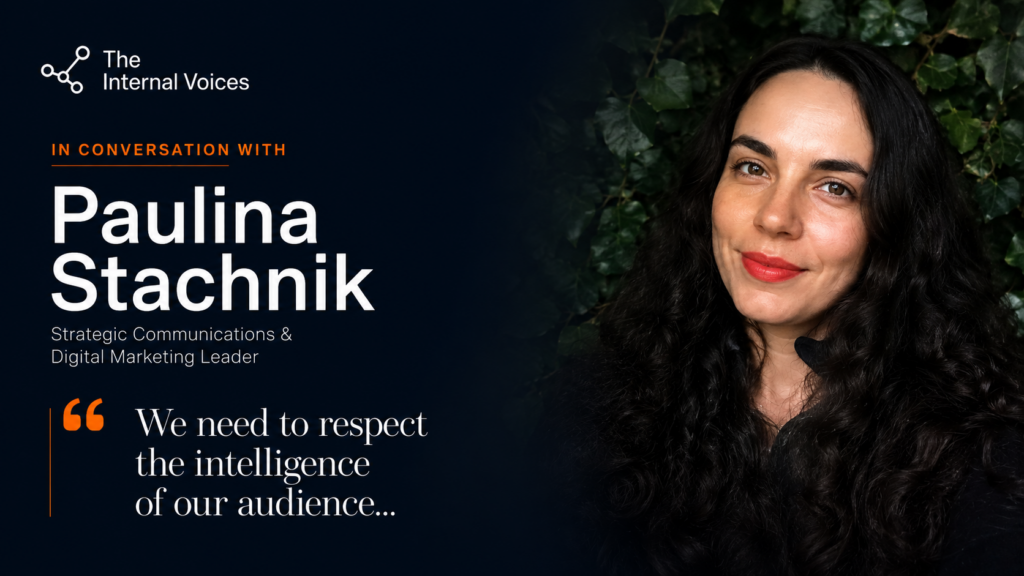
“We need to respect the intelligence of our audience and know that we still need to give them a quality product, even if we had a bit of help at the beginning.”
That sentence, in the context of our conversation, carries more weight than it might appear to. Respecting the intelligence of your audience is not a prompt engineering tip. It is the same principle that explains why trust is built through drips. It is the reason values have to be alive in every decision. It is the difference between communication that is produced and communication that is earned.
AI, in her experience, genuinely helps. At Women for Women International, when conflicts broke out, the organisation often needed to respond publicly within 24 to 48 hours. The news cycle did not wait. AI accelerated the drafting process in ways that mattered. It lowered the barrier for people who found the blank page intimidating. It made certain kinds of efficiency genuinely possible.
But she observed something else alongside those benefits.
“Anyone who’s plugged into AI will start to see if you’re using it without any kind of editing afterwards.”
The audiences that organisations have spent years building relationships with are not passive. They notice when the writing style shifts. They notice when the language becomes more generic, when the specificity that made an organisation’s voice recognisable starts to flatten into something that could have come from anywhere. They may not be able to name what changed. But they feel it. And what they feel, over time, affects whether they trust you.
This is not an argument against AI. It is an argument for understanding what your audience is actually receiving, which requires you to have read enough good writing to know the difference, and to care enough to close the gap.
“I recommend anyone who is working in communications to consistently take the time to read genuinely good writing – whether non-fiction, novels, or long-form articles. , That way it can still act as a benchmark for what you’re trying to achieve, even with AI’s help.
What the profession is becoming
Toward the end of our conversation, Paulina offered something that felt less like a prediction and more like an observation about what is already happening.
As a consultant, she is now doing the work that a team of five once covered: strategy, press, website, social media, emails, analytics.. AI has made that possible in ways it would not have been before. The capacity available to a single communicator has expanded significantly.
But the thing that allows that expansion to produce quality rather than volume is the same thing it has always been. Judgement. Context. The willingness to slow down and ask whether a message is actually saying what it needs to say.
“You have to interrogate AI. It’s programmed to have quite a confident tone. You have to really think critically about what it’s actually saying and push back on it when needed. One of my favorite prompts is ‘You are my ruthless mentor. Find the gaps in what I’m saying. Don’t sugarcoat.’”
The communicators who will define the profession over the next decade are not the ones who produce the most content the fastest. They are the ones who have built the reserves of trust, inside their organisations and with their audiences, that allow their communication to land as something more than noise.
Trust is not a campaign.
It is not a tone of voice document, a values statement, or an AI prompt.
It is what accumulates, drip by drip, in every decision an organisation makes about how it treats the people it is asking to believe in it.
Great content! Keep up the good work!