
Internal Communication: Between Professionalisation and Technological Disruption
- trinimaturana
- The Voices in English, Voces de la Industria
Índice
“Internal communication is fundamental part of organisational life. The management of it has the power to help organisations thrive.”
Oli Howard, Head of Membership & Product Portfolio at CIPD and Module Leader of the MA in Internal Communication Management https://www.ioic.org.uk/learn-develop/qualifications/masters.html, did not plan to end up in internal communication. His first formal role in the field came at Age Concern, a UK charity, and it was there that he discovered what he was looking for: a discipline directly connected with people. Since then, his career has taken him through senior roles at the Civil Aviation Authority, Scope, Royal Mail, SGN, and now to the CIPD, where he leads membership and product development while also teaching on the IoIC–Solent University Masters in Internal Communication Management.
In this interview for The Internal Voices, Oli reflects on what it takes to professionalise internal communication, how to earn credibility with leaders, why HR and comms must act as true partners, and how artificial intelligence has the potential to change the way we relate to each other at work.
Professionalising Internal Communication
For Oli, professionalisation is both urgent and profound:
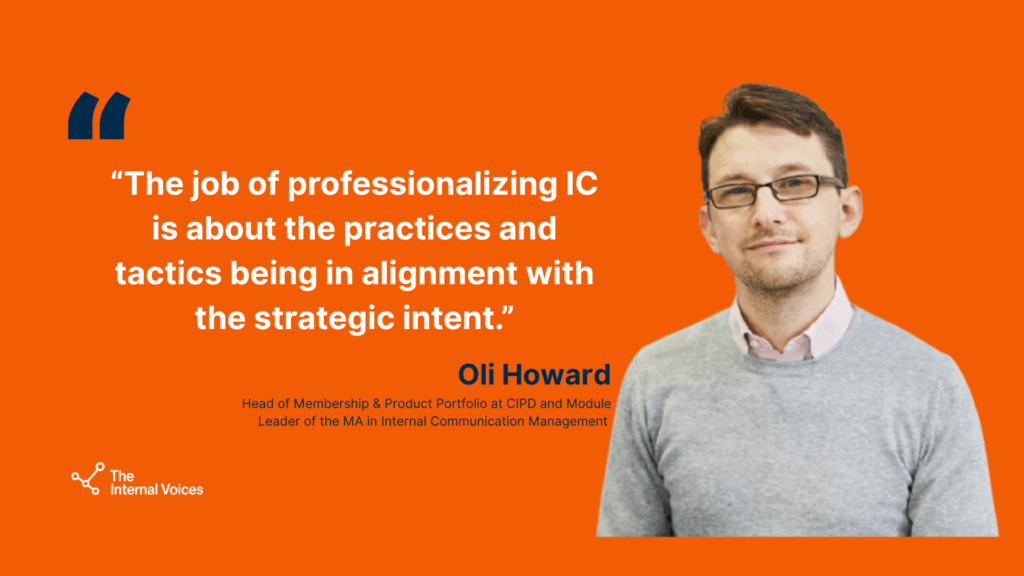
“The job of professionalizing internal communication is about the practices and tactics being in alignment with the strategic intent.”
He explains that internal comms, as an idea, began with a strategic purpose —helping employees and employers to understand each other so the organisation can function effectively— but too often the focus has been lost in channels and outputs, with unclear relationships to business outcomes.
That disconnect, he says, still limits credibility today:
“Yes, the function is definitely maturing. But a step forward is still needed in terms of both strategic alignment and reputation – and those things are very much related.”
Building credibility with leaders
One of the most provocative points in the conversation was how IC as a function can suffer from unhelpful preconceptions. Senior leaders, can sometimes see it as decorative or tactical – fine for celebrating employee contributions but not considered as a driver of real change. For employees, it can feel ‘additional’ – a source of emails and newsletters that seem unrelated to the core job.
“If what the internal communication function is known for is primarily the really kind of high production stuff —the big all-staff event, the glossy campaigns— then to managers it feels like a distraction, another thing being added to their infinite to-do list.”
For Oli, the challenge is to move past the perception of IC as “the team that makes things look good” and build genuine alliances with leaders. The goal is to demonstrate that internal comms is not decorative, but strategic —a discipline that helps organisations deliver on their objectives through alignment and coherence.
HR and Comms: a necessary partnership
The relationship between HR and comms is one Oli knows well. For him, it should not be a battle for territory but a partnership to design a consistent employee experience that, in turn, helps the organisation deliver its work.
“The experience that employees have at work is not created by any one department. It’s a combination of leadership decisions, HR, comms, IT, facilities… If you want a strong employee experience, you need partnership between all of them.”
That collaboration requires mutual respect, he adds. HR has constraints rooted in legal and regulatory frameworks that comms professionals sometimes underrecognise, while comms professionals can bring insight as well as skills and methods. Together, they can challenge each other constructively.
Evidence as a driver of change
As a Module Leader at IoIC’s master’s programme, Oli has long advocated for the role of an academic grounding for the work of IC professionals.
“We are, to our knowledge, the only Masters level program that focuses entirely on internal communication. Would it be a good thing for there to be more robust education programmes globally? Probably.”
Importantly, the Masters programme is not designed to be purely theoretical. Its aim is to provide professionals with an understanding of how to analyse organisations, achieve change through communication strategies and build strong relationships with stakeholders. The ambition, as he frames it, is simple but essential: a community of communicators with strong judgement, able to make evidence-based decisions that translate into direct benefits for organisations.
Artificial Intelligence: the imminent disruption
The inevitable topic was AI. For Oli, the question is not whether to use it, but how it will change culture and communication dynamics inside organisations.
“AI is already embedded in our digital workplace and will become more so… but what I think is most interesting is it will change the way people within organizations communicate with each other.”
The consequences, he reflects, could be far-reaching. As human- and machine-generated communications become less distinguishable, the establishing of trust, belonging, and team cohesion might be changed in ways we don’t yet fully understand.
“If three-quarters of the messages in your inbox are generated (or mostly generated) by AI, what does that do to your sense of who your colleagues are and how you see your role in the group?”
The challenge is not drafting faster newsletters (though the technology can and does clearly do this), but anticipating how these new technologies will change the ways employees relate to each other, and identifying where communication practices might be needed to keep the organisation functioning healthily.
Signs of progress
Despite the challenges, Oli recognises that the field is maturing:
“I see in our students’ work a gradually stronger alignment… more internal communication teams working with their leaders to identify a business problem that needs to be solved and coming up with a cogent internal communication response.”
Across the UK and beyond, internal comms is starting to be recognised as a strategic partner, not just a message delivery function. It is that transition we need to continue making as a profession.
Closing thoughts
The vision of Oli Howard is both critical and hopeful. He believes that internal communication as a profession will only achieve its potential if tactics align with strategy, if HR and comms act as allies, and if professionals commit to evidence-based, academically grounded practice.
His message is both a call to action and a warning: AI will inevitably change the rules of the game, but the role of internal communicators can become more vital if we observe the ways our organisations are changing and respond with the solutions needed.
Because at the end of the day, the central questions remain: are we helping employees and organisations understand each other better? Are we helping our organisations to perform?