
Listening for Real, Not Covering Up the Noise
- trinimaturana
- The Voices in English, Voces de la Industria
Índice
Regine Nelson on How Internal Communications Connects Purpose, Strategy and the Future with AI
Regine Nelson built her career moving between external and internal communications, with experience in companies like PayPal and now leading at Couchbase. Her path led her to specialize in something we rarely say out loud: the real mission of internal communications is not to fill channels, but to change behavior.
In this interview for The Internal Voices, Regine shares lessons from her journey in tech, her critical view of vanity metrics, and a strong conviction: AI can be a powerful ally, but it will never replace human judgment or cultural sensitivity.
From PR to Internal Purpose
Regine started out in agencies, focused on PR and media relations. But one internal project shifted everything:
“Oh my gosh, you mean I have a captive audience that I could engage with in a closed ecosystem and create bigger impact? And I was hooked.”
That moment made her fall in love with internal communications. Since then, she has worked on organizational change projects across global and multicultural environments, always with the same focus: showing that IC is not tactical, but strategic.
Measuring What Really Matters
Regine is outspoken about how many IC teams still measure the wrong things.
“Because at the end of the day, if people are just clicking on the link, but nobody’s reading it, that does nothing.”
For her, the point is not counting clicks but understanding whether communication shifts attitudes, conversations, and decisions. That’s how you connect communication with business outcomes and demonstrate evidence of impact, not just activity.
The Challenge of Asynchronous Work
We also talked about one of today’s big challenges: how to sustain culture and connection in remote and hybrid environments.
“The challenge I feel that we need to better work on is async communications. People do not really understand how to do that. They say they do, but they don’t.”
Regine insists that teams need to design systems for asynchronous communication that actually work, rather than pretending to “do async” while still relying on real-time interactions. And she reminds us that, in remote settings, intentional human connection is not optional, it’s essential.
AI: A Tool, Not a Substitute
Artificial Intelligence came up as both a possibility and a risk.
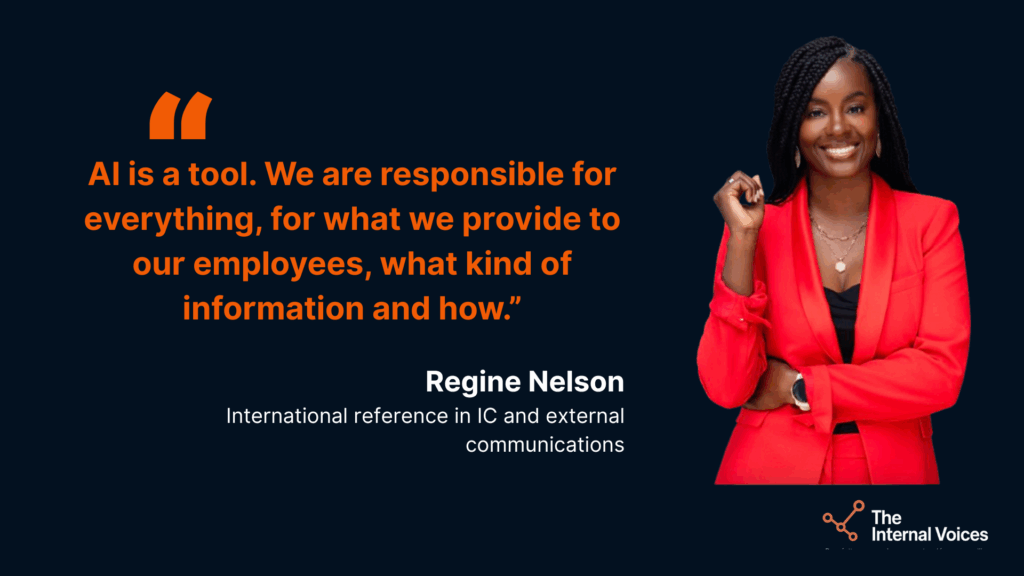
“AI is a tool. We are responsible for everything, for what we provide to our employees, what kind of information and how.”
She acknowledges the power of AI to amplify small teams “a lot of us are teams of one or two” but is clear that professional judgment, ethics, and cultural context cannot be delegated to a machine.
Academia and the Next Generation
Another critical point in her reflection is academia’s slow response to the profession’s real needs.
“The problem is academia is not preparing internal comms professionals for the real world. They are still teaching them the basics, but not how to influence culture or use technology.”
Looking ahead, she envisions hybrid professionals who can merge storytelling, data, culture, and technology:
“The next generation of internal comms professionals will need to be storytellers, analysts, and tech-savvy at the same time. Otherwise, they will not be relevant.”
Closing
Regine Nelson’s vision is a call to reframe the discipline with courage and purpose. Her message is clear: fewer vanity metrics, more real impact; less tactics, more strategy; less noise, more listening.
And as she puts it, internal communications must ultimately be rooted in something deeper: love for people and a belief in purpose.
“The best way for me to love people is to make sure that they are communicating with each other effectively and understanding what their purpose is.”