
The Interpretation Layer AI surfaces signals. Communication creates meaning.
- trinimaturana
- The Voices in English, Voces de la Industria
Índice
Some conversations confirm what you already believe about your discipline. Others expand it.
My conversation with Sam Drexler did both.
Sam has spent the past six years at Google advising leaders on executive and internal communications, currently working on transformation initiatives connected to the future of work and artificial intelligence. From San Francisco, where he works with teams building products used by billions of people, he sits at a unique intersection between leadership, communication and technological change.
Yet what struck me most during our conversation was not the technology.
It was the clarity with which he described communication as a leadership capability.
“Companies succeed or fail based on leaders communicating strategy, culture, and change. Leaders may have incredible ideas and strategy, but if people don’t understand it or don’t feel connected to it, it doesn’t move the organisation forward.”
For anyone working in internal communication, the statement lands with quiet familiarity. Strategy often travels perfectly inside boardrooms and strategy decks. Its journey across the organisation is far less predictable.
Internal communication lives precisely in that gap.
From agency work to organisational storytelling
Like many communicators, Sam did not begin his career inside organisations.
He started in agency, at FleishmanHillard, working across corporate communications, social media, and media relations.
It was there that he discovered something unexpected.
“What fascinated me most was the opportunity to explore big ideas and help people share their stories.”
During the interview I immediately recognised the feeling.
Many of us arrive in internal communication almost by accident. What keeps us here is the realisation that communication inside organisations operates at a completely different level. It shapes how people understand the work they do and how that work connects to something larger.
In Sam’s case, that discovery eventually led him to move in-house. More than six years later, his work at Google revolves around helping leaders translate high-level strategy into a vision for the future and simple, tangible actions employees can understand and act on.
Communication as a leadership partnership
When people imagine internal communication inside a company the size of Google, they often picture massive channels, newsletters, or global campaigns.
Sam describes something much more relational.
“We work closely with senior leaders not just to write messages, but to advise them. Together, we think through how to build trust with their teams, how to communicate the strategy, and how to land difficult decisions. It’s our role to provide honest counsel to help them and Google succeed.”
This is where internal communication becomes strategic.
Not because of the channels it manages, but because of the conversations it shapes.
During the interview we spoke about something that both of us have observed in different contexts. Technical leaders are extraordinarily smart in their fields, but few leaders have been trained how to translate complexity into clarity.
“That’s where we come in with our storytelling skills, empathy, and intuition. We help build bridges from executives to employees, so everyone feels connected to the mission, vision and priorities. Communication isn’t just a team, it’s a critical capability that drives positive outcomes for the business.”
Much of the work happens quietly in that space coaching leaders, shaping ideas before they become messages, and helping strategy travel across the organisation.
Leadership without hierarchy
Another part of the conversation touched on leadership inside complex organisations.
In companies where thousands of people collaborate across functions and geographies, influence does not belong exclusively to formal leaders.
Sam describes a form of distributed leadership that resonates strongly with how many modern organisations operate.
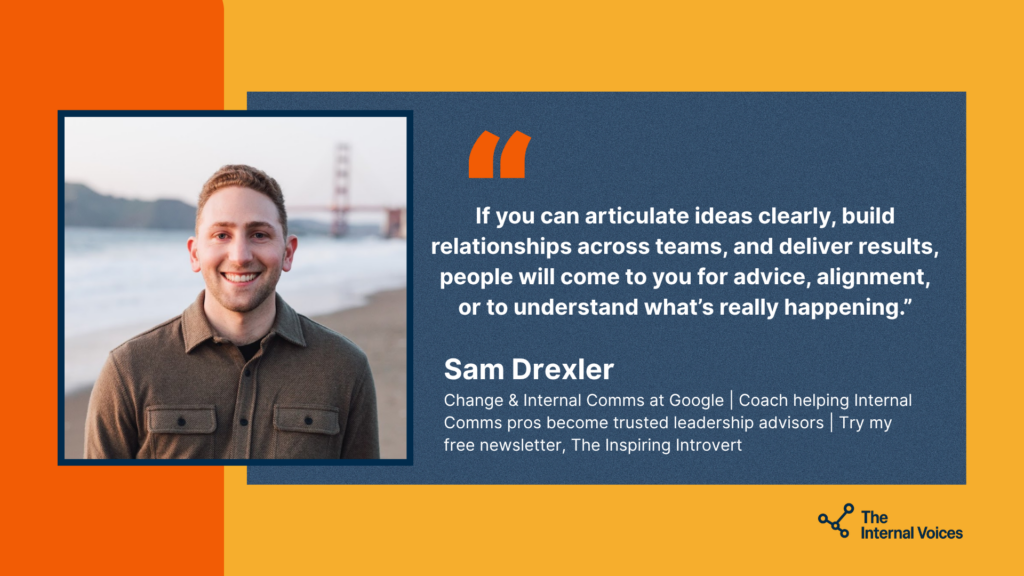
“You don’t need to manage hundreds of people to have influence. If you can articulate ideas clearly, build relationships across teams, and deliver results, people will come to you for advice, alignment, or to understand what’s really happening.”
Listening to him, I found myself thinking about how often internal communication tries to identify formal spokespersons or employee ambassadors.
Sam’s perspective suggests something more organic. Influence tends to emerge where credibility, relationships, and clarity intersect. One of the roles of communication is to recognise and amplify those voices.
AI as a creative collaborator
Naturally, the conversation eventually turned to artificial intelligence.
Given Sam’s role inside Google, one might expect a highly technical explanation. Instead, he approached the topic with a communicator’s mindset: how technology changes the way ideas are created, shaped, and distributed.
He described how he builds Gemini Gems — personalised AI assistants designed to support very specific tasks, rather than repeatedly rewriting the same prompts.
“I’ve trained Gems on various executive voices to help me get their style and tone right. Another reviews my plans for events and ensures I’m not missing anything. Another is trained as a ruthless editor, cutting 20% of the word count while preserving the core message.”
He also sees enormous potential in how AI can transform content across formats.
“One of the opportunities I’m most excited about with AI is content transformation. With various AI tools, a long-form video can be turned into short clips, a podcast, article, and infographic. This would’ve been cost-prohibitive before. It’s possible now. But I always make sure to thoroughly review, validate, and edit any AI outputs.”
There is enormous opportunity to use AI to make communication more engaging.
As Sam put it during the conversation, we are only just scratching the surface.
The interpretation layer
This is where the role of communication begins to evolve.
Artificial intelligence can analyse information, generate drafts, and scale production. Yet organisations still need people capable of interpreting what those signals actually mean for employees, teams, and decisions.
Sam articulated this tension clearly when we spoke about the future of the profession.
“Now anyone can build an AI that writes like them. But if you don’t have original ideas, the output will be bland and boring. AI can help you express your thinking, but it should never replace the thinking itself.”
He believes AI will ultimately create more space and opportunity for many of us to lean into the parts of communications that brought us to this profession in the first place.
Understanding people.
Interpreting organisational dynamics.
Helping leaders connect strategy with everyday work.
Internal communication increasingly operates as the interpretation layer inside organisations.
Technology accelerates the signals.
Communication creates the meaning that allows people to act.