
Beyond the Prompt: Jonas Bladt Hansen on the Next Level of Internal Communication
- trinimaturana
- The Voices in English, Voces de la Industria
Índice
Jonas Bladt Hansen speaks about artificial intelligence with an unusual calm. There is no hype in his tone, no urgency to impress with tools. His focus rests elsewhere. On structure. On discipline. On how internal communication defines its own value in a moment of technological acceleration.
Based in Denmark, Jonas is the founder of Next Level IC, a consultancy dedicated to strengthening internal communication as a professional capability. Over the past seven years, he has worked with organisations such as the Danish National Bank, the European Commission’s representation in Denmark, Telenor, Falck and the Norwegian sovereign wealth fund. Across more than sixty companies, his work has centred on helping communicators integrate generative AI not as spectacle, but as practice.
He is the first Danish voice featured in The Internal Voices.
His path into internal communication began long before AI entered the conversation. Early in his career, he encountered a familiar organisational contradiction: strategy crafted at board level that never fully travelled beyond it.
“We had a 50-slide strategy deck that looked extremely convincing for the board, but not really for middle management or employees. It was well argued, it had clear direction, but it wasn’t something people could relate to in their everyday work.”
That gap between strategic intention and lived reality became his entry point. Communication, in his experience, was less about producing messages and more about creating connective tissue inside the organisation. Artificial intelligence now intensifies that responsibility rather than replacing it.
From Speed to Substance
In many organisations, AI has already reshaped the daily workflow of communication teams. Drafting, translating, summarising and tone adjustment have become faster and more accessible. The gain in efficiency is tangible.
Jonas describes this first stage with precision.
“Level 1 is chatbot usage. That’s what most of us are doing right now. We’re using AI to improve our day-to-day tasks. We’re writing faster, we’re structuring content more easily, we’re generating ideas more quickly. And that’s fine. It’s helpful. But if we just stay there, we become a kind of AI middleman.”
He continues without raising his voice, simply following the logic to its conclusion.
“And then the output we create will be compared directly to the cost of a Copilot subscription. Your salary will be compared to what it costs to get ChatGPT or Copilot to create that output. And if the AI can produce something that is 80 or 90 percent good, the business might decide to take that risk and save the money.”
The point lands quietly. When value is defined as output, output becomes a commodity. Technology excels at commodity production.
What then differentiates the discipline?
Jonas does not frame the answer as resistance to automation. He frames it as expansion of scope.
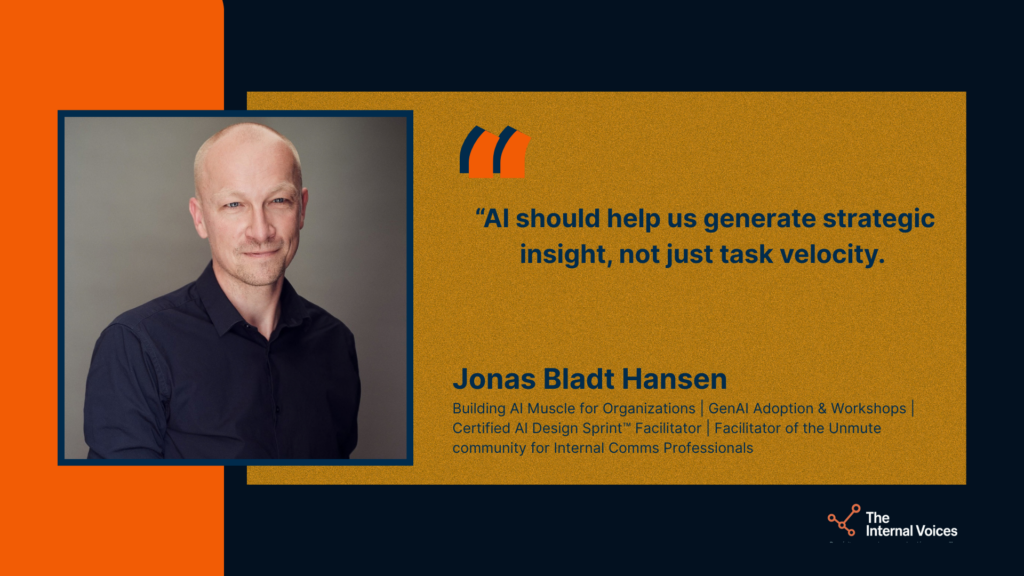
“AI should help us generate strategic insight, not just task velocity. We now have the ability to analyse what’s actually happening inside the organisation at scale. We can look at the questions being asked in town halls, the discussions happening on collaboration platforms, the feedback from surveys. We can identify patterns and see where leadership narratives and employee concerns don’t fully align.”
This is not about replacing judgement. It is about enriching it.
“You might be talking about one priority at the executive level, but people might be worried about something entirely different. If we can document that gap clearly, we change the conversation with leadership.”
At that point, internal communication shifts position. It stops being primarily a delivery mechanism and becomes an interpretive function. The discipline gains influence by clarifying organisational reality rather than amplifying executive messaging alone.
Designing the Capability
Our conversation then moves from individual usage to collective maturity.
“Right now, we’re using AI in silos. One person is experimenting with prompts. Another is automating translations. Someone else is testing how to adapt tone. But we rarely sit down as a team and ask: where do we actually want to use AI? Where does it make sense? And where is human work indispensable?”
The question reveals something deeper than tool adoption. It exposes how intentionally the function designs itself.
Mapping workflows, identifying repetitive tasks and clarifying decision points are not technical exercises. They are reflections of professional identity. They define what the team considers core value and what it considers supportive activity.
In this sense, AI becomes a mirror. It reveals whether internal communication understands its own processes well enough to redesign them.
Automation, when approached deliberately, strengthens the system. When approached individually and without coordination, it fragments practice.
Presence and Context
Despite his engagement with advanced tools, Jonas repeatedly returns to something more grounded.
“One of the most important things we can do as communicators is leave the comfortable seats in headquarters and go out into the business. Understand what people are actually concerned about. AI can analyse data, but it cannot replace contextual understanding.”
That distinction matters. Technology can surface patterns. It can highlight recurring themes. It can detect shifts in tone. Interpretation, however, requires proximity to operational reality.
Internal communication earns credibility when it integrates analytical insight with lived context. Data without understanding risks abstraction. Context without data risks anecdote. The discipline matures when both dimensions reinforce each other.
A Nordic Approach to Integration
There is also something distinctly Nordic in the way Jonas describes adoption. AI is not positioned as disruption for its own sake. It is framed as capability building. Workshops, structured learning journeys and community-based experimentation shape integration as a shared process rather than an individual race.
This orientation reflects a broader cultural expectation. In markets such as Denmark, professional functions are evaluated by the coherence they create and the trust they sustain. Influence grows from alignment, not volume.
Within that environment, internal communication strengthens its position by demonstrating interpretive clarity and strategic relevance.
The Discipline We Are Becoming
As our conversation draws to a close, the focus shifts from technology to identity.
“We are at a point where AI can either reduce internal communication to efficiency if we let it, or elevate the function to strategic interpretation. The difference will depend on whether we consciously design our role and define where we create value.”
He does not present this as a dramatic crossroads. He presents it as a professional choice.
Artificial intelligence is already embedded in organisational life. Its presence will continue to expand. The more consequential question concerns how the discipline positions itself within that expansion.
Internal communication can define itself through production capacity, measuring its success by speed and output. It can also define itself through interpretive capacity, shaping leadership conversations by clarifying organisational reality.
The tools will continue to evolve. They will accelerate workflows and expand analytical reach. The direction of the discipline, however, depends on ambition.
And ambition, in this case, is less about mastering prompts and more about claiming responsibility for how organisations understand themselves.