
Dominic Walters: “Internal Communication is finally leaving its teenage years”
- trinimaturana
- The Voices in English, Voces de la Industria
Índice
Some conversations don’t just inform—they rewire how you understand an entire profession. Speaking with Dominic Walters, President of the Institute of Internal Communication (IoIC) and one of the most influential voices in the industry, was exactly that: a moment of clarity about what Internal Communication was, what it is becoming, and what it still resists confronting.
This is a synthesis of insight from someone who has helped shape the strategic backbone of Internal Communication in the UK and beyond for over three decades.
The Profession That Started Tactically and Slowly Grew Up
Dominic entered Internal Communication in 1993, a time when the field barely existed as a defined discipline.
“It was quite new and it was a very young profession.”
Back then, he notes, only large organizations “could afford to… invest in that sort of thing.” Internal Communication was still often considered a set of outputs: newsletters, collateral, and messaging.
Even today, he observes that the global maturity of IC is uneven:
“ What’s different is where different countries are in terms of how they see internal communication.”
And yet, the fundamentals are universal:
“If you can connect your people better, if they’re clear on what they need to do and why, if they are listened to and get regular feedback… that works in any organization.”
For him, the profession is no longer in its infancy but it’s still maturing:
“In the Institute we talk about us (internal communication) being adolescent.”
That adolescence, however, is not a weakness. It is the stage where Internal Communication is finally forming its strategic identity.
“We’re creating our own identity. We’re starting to find our feet as a profession.”
Stop Talking About Communication. Start Talking About the Business
Dominic is candid about a recurring problem in the profession:
“People in communication often felt they had to prove their credentials… so they would talk about channels and methods and that would confirm in the senior person’s mind that the communicator was a technician.”
This mindset, he explains, has kept Internal Communication locked in a subordinate role for decades. His proposed shift is radical and brilliantly simple:
“Don’t talk about communication, talk about business issues.”
He draws a parallel with other strategic professions:
“A senior accountant doesn’t go into a meeting saying ‘Here’s a list of accounting good practice’. They talk about business issues.”
Influence is not gained by showcasing technical skill. Influence is gained by showing how communication enables decisions, performance, and clarity.
For Dominic, the evolution of the profession depends on this transformation: from producers of outputs to partners in organizational sensemaking and business impact.
Leadership, Conversation and the Art of Sensemaking
Dominic’s work with leadership teams across industries has reinforced a central truth: Internal Communication is fundamentally human before it is operational.
He explains the difference between senior leaders and line managers with precision:
“The big difference is line managers tend to focus more on explaining things… what this means for our work… whereas senior leaders tend to focus more on the big picture, the vision, where we’re heading.”
But the core skills are the same:
“Being able to articulate messages clearly, using simple language, asking questions, making things relevant, using stories.”
In his view, the path forward is less about glamorous presenting and more about sensemaking. And here aparece lo esencial:
“The role of the line manager is to help people make sense of stuff.”
This resolves one of the biggest misconceptions among leaders:
They think “communication” means performance. Dominic reframes it as clarity, context, and conversation.
No propaganda. No memorized scripts. Just the ability to help people understand what is happening and what it means for them.
Measurement: Beyond Clicks and Vanity Rituals
Dominic’s view on measurement is precise and uncompromising.
“Did people use it?”
“Did they like it?”
“Did it change behavior?”
“And if it changed behavior, did it deliver on the performance of the business?”
Most teams stop at metrics of usage or satisfaction. But the strategic leap happens here:
“What do you need people to do? How will you know if they’re doing it?”
Measurement begins with behavioral intention not activity volume.
And as él mismo asegura, credibility comes from demonstrating impact, not claiming expertise:
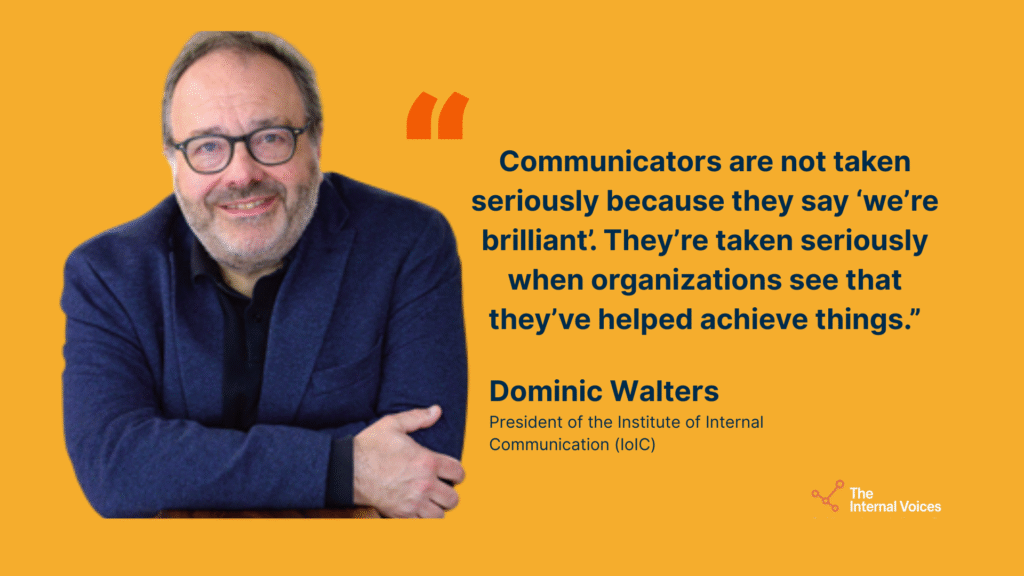
“Communicators are not taken seriously because they say ‘we’re brilliant’. They’re taken seriously when organizations see that they’ve helped achieve things.”
AI: From Fear to Strategic Leverage
Dominic ha visto un cambio radical en menos de dos años:
“The debate has shifted… from ‘AI is coming for us what can we do’ to ‘how do we use it effectively?’”
He is particularly excited about what AI can do for insight work:
“I’ve seen it being used for pulling together themes from research… what took months now takes minutes.”
But he stresses something essential: AI is not a threat—unless used blindly.
“AI is a tool. It is not a human and never will be a human.”
And trust depends on transparency:
“People accept AI more when they understand how it’s been used… the ethics are really important.”
For him, AI should free communicators from the tactical grind and bring them closer to conversations, leadership, and sensemaking.
Closing: A Profession Finally Finding Its Identity
Dominic Walters closes with one of the most lucid assessments of where Internal Communication stands today:
“We’re starting to create our own identity. We’re starting to find our feet as a profession.”
Internal Communication is stepping out of adolescence. Not because it has fully matured, but because, it can unleash its true power:
To connect. To clarify. To humanize. To help people make sense of organizational life in a world that refuses to stop changing.
The adulthood of the discipline is not ahead of us. It is beginning now. And leaders like Dominic are illuminating that path with rigor, honesty, and vision.