
AI as a Strategic Colleague: The Perspective of Erik Sebok
- trinimaturana
- The Voices in English, Voces de la Industria
Índice
Practical solutions in a digital world
As Senior Internal Communications Advisor at AtkinsRéalis, Erik Sebok works across strategy, planning, content, campaigns, leadership engagement, inclusive comms, and hybrid events for a complex global engineering business. He’s known for his hands-on, practical approach that’s always focused on solutions that work in the real world.
“Most companies have the same challenges when it comes to internal comms. The difference is in how we approach them.”
That pragmatic mindset shapes his vision for the field. Internal communication, he says, is still a young discipline. Even in mature markets like the UK, it’s often seen as tactical rather than strategic.
“I see these stories all the time on LinkedIn: our advice being questioned, the role still being considered ‘tactical’, and everyone assuming they’re communicators just because they can talk.”
For Erik, it’s a sign of how slowly organisations are recognising the true value of internal comms as a driver of business strategy. His approach is to bridge that gap: combining practical solutions with a clear focus on strategic impact.
AI: From shortcut to strategic enabler
When it comes to AI, Erik doesn’t speak like an early adopter chasing hype; he speaks like a craftsman who’s found a new instrument.
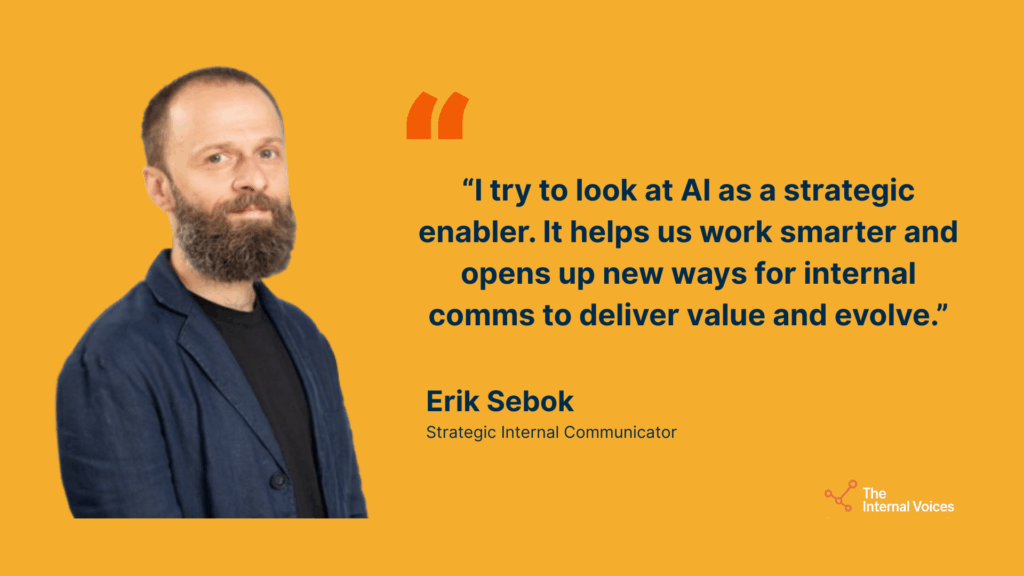
“I try to look at AI as a strategic enabler. It helps us work smarter and opens up new ways for internal comms to deliver value and evolve.”
He rejects the notion that AI’s main value lies in time-saving. Instead, he sees it as a means to elevate thinking and quality of work, expand capacity and influence, and refine strategy.
As he puts it, AI should help communicators think, not rush.
“The other real benefit is the opportunities for upskilling and development. AI should help us think better, not just move faster.”
But with that capability comes a need for attention to detail. Erik is thoughtful about the risks of over-reliance and the occasional shortcuts he sees in the profession.
“AI is a powerful tool, but it’s our responsibility to ensure the output is accurate. If we don’t take the time to check it, the consequences are on us. It’s about thoughtful use, not just fast use.”
He believes the obsession with shortcuts – the idea that AI can magically ‘do the work for you’ – is both misguided and dangerous. Communicators, he says, must still think, question, and decide.
“You can’t skip the fundamentals: you still have to think critically, know your business inside out, ask smart questions, and recognise quality when you see it. AI just helps you get there faster.”
A new colleague, not a replacement
Erik compares working with AI to briefing a new colleague on a comms project.
“The quality of your AI output depends on the quality of your input. Give it context, background, and specifics or you’ll end up with something generic that misses the mark.”
Erik takes a pragmatic approach to AI, choosing to focus on mastering one platform (like Microsoft Copilot) rather than chasing every shiny new tool.
“I just want to get really good at the one I use every day at work. The rest isn’t a priority right now, because they’re not part of my workflow.”
That focus, he adds, helps him stay productive and grounded in what matters: using AI to better understand its strategic value in internal comms.
The future of internal communications with AI Agents/Bots
Erik can see the next evolution of internal communications as a partnership between humans and AI agents/bots: specialised digital colleagues trained for distinct tasks like strategy, planning, writing, research, learning etc.
“This can lighten the load on small IC teams and can scale their impact and focus on what matters most. The possibilities are endless.”
He’s clear, though, that this future won’t arrive at the click of a button. Erik’s own experience shows that effective AI collaboration is built on hours of experimenting, playing around, refining, and iterating.
“People think AI is plug-and-play. You just type a few words and it’s done. But the reality is, it takes real work, learning, experimenting, and adjusting. Once you put the effort in, though, it can make your life much easier and your work much smarter in the long run.”
For Erik, the real promise of intelligent agents is not speed, but strategic enablement: freeing communicators to focus on creativity, critical thinking, and building connections, while AI handles the heavy lifting behind the scenes.
The next generation of communicators
Erik is clear about the future of internal communications: technology will never replace the fundamentals. Tomorrow’s communicators need digital fluency, but also the ability to manage stakeholders, listen actively, and think strategically.
“You need a strong strategic mindset to be able to connect campaigns to business goals and make them resonate with different groups. AI can’t replace your understanding of the business, your judgment, empathy, or the influence skills that are uniquely human.”
For Erik, those who blend digital skills with human insight and influence will shape the future and drive real impact.
It won’t be optional for long…
Erik is convinced that in a few years, using AI will no longer be a choice but an expectation. What matters now is how communicators use this time to shape its role in the profession.
“A lot of people are talking about it. Everybody has opinions. But I don’t see a lot of showing beyond the usual timesaving and efficiency tips. We need more people to experiment and demonstrate that AI has the potential to make us and our profession more strategic and more relevant.”
Closing thoughts
Erik’s approach to AI and internal communications is both practical and purposeful.
“Every day, I’m genuinely curious and excited to see what AI will help me do differently or better.”
In a world full of noise and automation, his enthusiasm stands out. Not because it’s flashy, but because it’s rooted in curiosity, discipline, and a drive to make a real impact. For Erik, the future of communication is about being thoughtful, strategic, and human.