
Edeje Onwude: Artificial Intelligence and the Next Generation in Internal Communications
- trinimaturana
- The Voices in English, Voces de la Industria
Índice
In Part 2 of our conversation with Edeje Onwude, an emerging voice in Internal Communications, we turned our focus to the immediate future of the discipline. The arrival of AI, the still pending role of academia, and the challenge of shaping the professionals that internal comms will need in the next decade.
From marketing to internal communications: a professional transformation
Edeje started her career in brand marketing. That commercial background gave her a different perspective: understanding how narratives of value are built. But the transition to internal communications confronted her with something deeper. Here it was not about selling a product, but about fosteri sustaining a culture.
“In marketing, the aim is to sell a product (Conversion). In internal comms, you create belonging (Connection). That’s a whole different game.”
Her personal evolution also reflects the transition many IC teams must make: leaving behind the logic of conversions and superficial metrics to embrace cultural and strategic responsibility.
AI: a tool of power with purpose
Artificial Intelligence is everywhere, but for Edeje the risk is that it remains at a superficial level. It is not enough to use it to draft messages faster. Its real potential lies in listening at scale, detecting cultural patterns and anticipating cracks in trust.
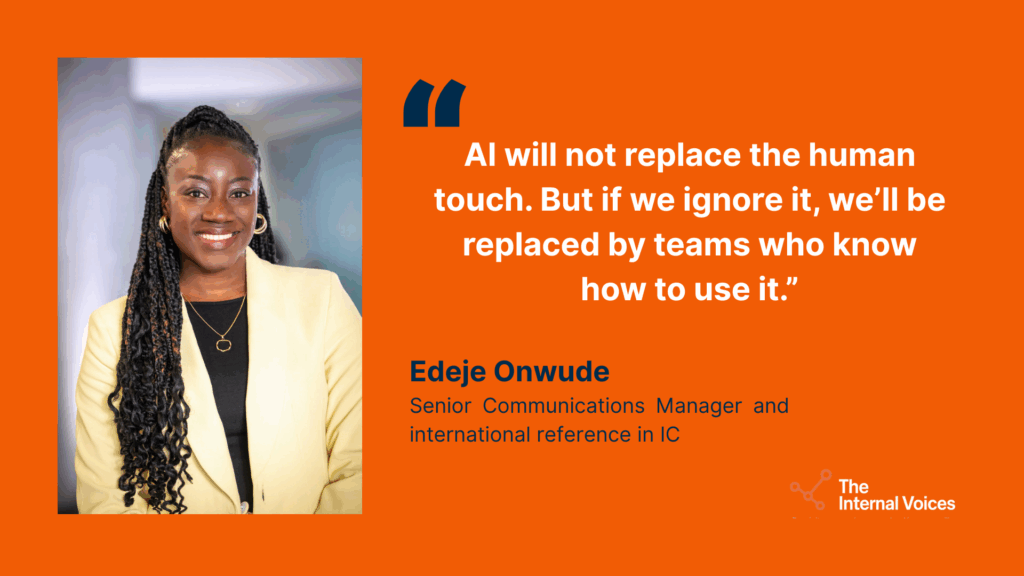
“AI will not replace the human touch. But if we ignore it, we’ll be replaced by teams who know how to use it.”
The message is clear. AI is not an accessory. It is a new muscle that IC must learn to train in order to sustain its strategic role while always keeping human sensitivity at the center.
Academia: the missing link
When it comes to training, Edeje points directly at academia. She argues that Internal Communications is largely invisible in universities; rarely part of the curriculum, and when it appears, treated as a side note rather than a strategic discipline.
“As part of my role as an #IChoseIC Ambassador, I visited a university career fair and 90% of the communications undergraduates I spoke to had never even heard of Internal Communications. The one student who had, knew about it only because she’d applied for an internship, but she still had no idea what it actually involved.”
For Edeje, this lack of visibility is holding the profession back. It narrows the pipeline of capable new talent and reinforces the perception of IC as secondary
The future professionals of IC
When asked how she envisions the professionals who will lead the discipline in 10 years, her answer was direct. They will be hybrid strategists. People able to master narrative, data, culture and technology with equal fluency.
“The next generation of internal comms professionals will need to be storytellers, analysts, and tech-savvy at the same time. Otherwise, they will not be relevant.”
Edeje emphasizes that organizations must begin cultivating this profile now by investing in training their current teams. At the same time, industry associations have a critical role to play in addressing the issue at a structural level – for example, by advocating for Internal Communications to be properly represented in academia.
Final Thoughts
If in Part 1 of this interview Edeje warned us about the risk of going backwards, in this second part she leaves us with a more hopeful roadmap. Embrace AI with purpose, push academia to catch up, and prepare professionals who integrate culture and technology to be fit for the future.
The future of Internal Communications will not be defined by more newsletters or campaigns. It will be defined by the ability to design culture with data, narrative and human sensitivity. The challenge now is to ensure the function claims that future , not as a support role, but as a strategic force.