
Beyond Feeling: Why Internal Communication Must Pivot to Performance in the AI Era?
- trinimaturana
- The Voices in English, Voces de la Industria
Índice
Some conversations don’t reassure you, they confront you.
Talking with Mike Klein felt less like an interview and more like a stress test for the discipline of Internal Communication itself. Not because of the technology we discussed, but because of the uncomfortable conclusions it forces.
Internal Communication, Klein argues, is standing at a crossroads. And many teams don’t realize how close they are to the edge.
The Existential Threat: From “Feeling” to “Doing”
For years, Internal Communication has positioned itself as the guardian of engagement, belonging, and employee sentiment. Engagement scores, pulse surveys, likes, clicks—metrics that feel reassuring but rarely survive scrutiny at executive level.
Klein challenges this head-on:
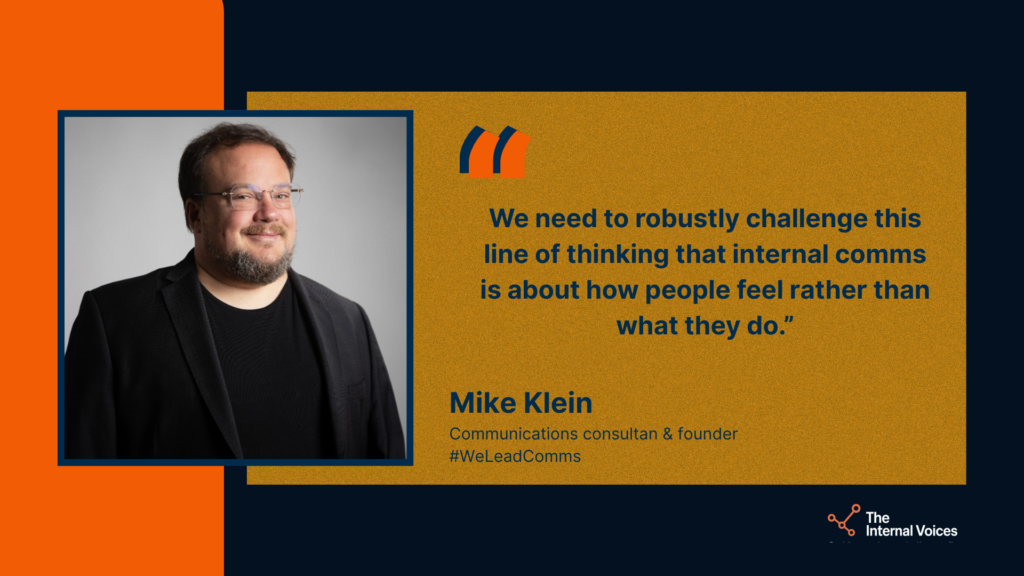
“We need to robustly challenge this line of thinking that internal comms is about how people feel rather than what they do.”
The danger is not philosophical. It is structural. If IC continues to frame its value around emotion alone, it risks being perceived as organizational palliative care; comforting, well-intentioned, but ultimately non-essential when budgets tighten.
Klein is blunt about the consequence of this positioning:
“If it’s totally seen as palliative care for employees, organizations are going to decide it’s not worth the money.”
This is the existential threat he keeps returning to, not the loss of relevance, but the loss of legitimacy.
Why the ‘Seat at the Table’ Narrative Keeps Failing
Internal Communicators often blame access for their lack of influence. Klein flips the diagnosis.
The problem is not that IC isn’t invited into strategic conversations. The problem is that many practitioners arrive without the language of performance.
Clicks, engagement scores and sentiment dashboards do not translate into decisions. They do not move capital. And they do not answer the question executives care about most: what changed because of this?
As Klein noted during the interview, credibility at senior level is earned, not requested:
“People talk incessantly about why they don’t have a seat at the table… and I would say about 90% of those people either couldn’t understand what’s going on at the table or don’t have credible dollarized measures to throw across that table.”
Until IC can demonstrate a clear line between communication and organizational outcomes, the “seat at the table” will remain symbolic at best.
AI Is Not a Tool. It’s an Accelerator of Reality
Much of the conversation around AI in Internal Communication is still framed as tooling: which platform, which model, which assistant.
Klein is unequivocal about how misplaced that focus is.
AI is not just automating tasks. It is accelerating work while organizations simultaneously reduce headcount. Execution is being compressed. Time for deliberation is shrinking. And employees are increasingly pushed into decision-making roles earlier and faster than before.
As he put it during the conversation:
“AI is speeding up the pace of work at the same time that organizations are reducing headcount.”
In that environment, the bottleneck is no longer production. It is judgment.
This is where Internal Communication either becomes critical or collapses under its own irrelevance.
Clarity Is the New Value Proposition
As work accelerates, confusion becomes expensive.
Employees do not need more messages. They need decision clarity: what values actually mean in practice, how trade-offs are made, and where escalation stops.
Klein sees this as IC’s most strategic contribution in the AI era:
“Internal communication can do a ton to increase that clarity… what do the values mean? What do the principles mean? What are the rules of the game?”
Without clarity, speed creates chaos. With clarity, autonomy becomes possible.
AI doesn’t replace Internal Communication. It exposes whether it has done its job.
A Discipline at a Crossroads
Internal Communication now faces a choice. Remain focused on how people feel and risk being sidelined as budgets tighten. Or pivot decisively toward performance, clarity and behavioral impact.
Mike Klein doesn’t offer comfort. He offers a warning and an opening. And that reckoning has already begun.