
Clean Energy, Dirty Cultures: The Invisible Incoherence of Transition
- trinimaturana
- Reflexiones y Opinión, The Voices in English
Índice
Europe, with Denmark acting as one of the great global laboratories for renewable energy, has embraced the energy transition as an unquestionable strategic priority.
The narratives are perfectly aligned: renewables, net zero, sustainability, future-proof. Investments are advancing at a breakneck pace. Technology is delivering. Artificial Intelligence is optimizing grids, predicting consumption, and promising unprecedented efficiency.
But there is a question rarely asked with the same gravity in boardrooms:
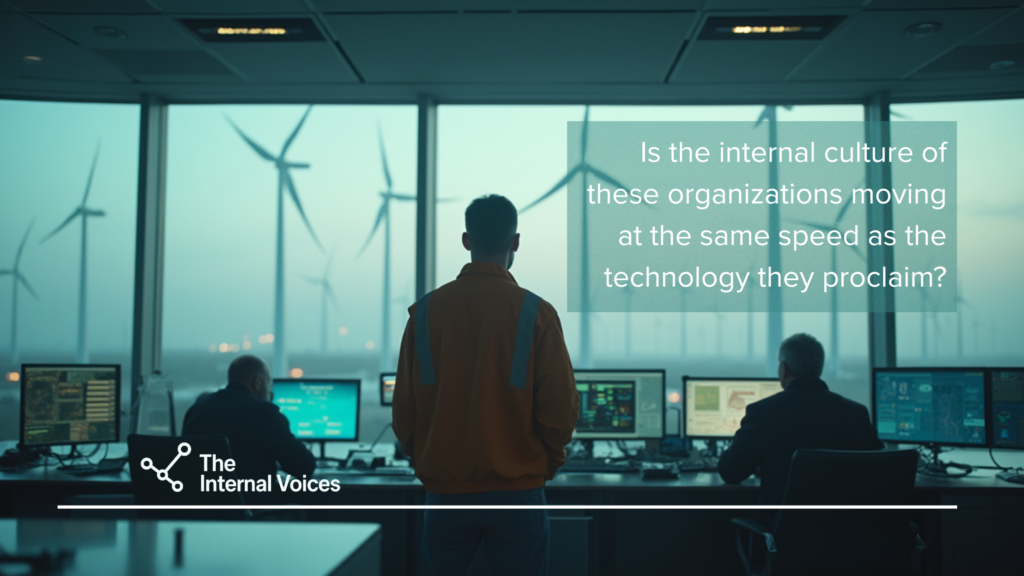
Is the internal culture of these organizations moving at the same speed as the technology they proclaim?
There is nothing more fragile than a structural transformation built upon a culture that doesn’t understand it, hasn’t processed it, or simply doesn’t see itself reflected in it.
When we speak of “dirty” cultures, we aren’t referring to a lack of values or intent. We are talking about cultures cluttered by unresolved tensions, by narratives that don’t speak to each other, and by changes that are announced but never truly integrated.
When Transition is Communicated Outward but Ignored Inward
Energy companies are often impeccable in their external storytelling. They produce polished sustainability reports, inspiring brand campaigns, and ambitious public commitments.
However, behind closed doors, the atmosphere is often different:
- Many employees struggle to translate “Net Zero” into the concrete tasks of their daily roles.
- Teams feel that AI and new technologies are erasing the value of their historical expertise.
- Amidst this uncertainty, leaders often communicate technical certainties while avoiding difficult human conversations
The energy transition is sold as the future, but for many employees, it is experienced as a loss. It is within this silent tension, not in the technology, where even the most solid transformations begin to crack.
The Foundational Error: Treating Transition as a Technical Deployment
The energy transition is not merely a shift in the energy mix. It is a shift in meaning. It requires redefining what we value as success, how we measure our impact on the planet, which stories we leave behind, and which professional identities must transform, or even disappear, for others to emerge.
When organizations approach this process solely through engineering, regulation, or investment, they start from a dangerous assumption: that people will automatically adapt to a narrative they never helped build.
Culture cannot be an appendix to the business plan; it must be its engine.
Colliding Narratives: The Source of Internal Cynicism
In many companies today, two worlds coexist without speaking to each other:
- The Corporate Narrative: Progress, innovation, purpose, and the cutting edge.
- The Daily Experience: Uncertainty, professional grief, and the fear of becoming irrelevant in the “new era.”
When these two realities fail to integrate, cultural incoherence emerges. Incoherence is the fuel for cynicism, distrust of leadership, and passive resistance. It isn’t that people reject the future; it’s that no one helped them understand their place within it.
The Role of Internal Communication: From Messengers to Architects of Meaning
This is where Internal Communication (IC) stops being a support function and becomes critical infrastructure for the transition. Its job is not to “tell” the change, but to make it processable.
In energy transition processes, IC fulfills a role that no other function can assume with the same depth:
- Translating Energy Purpose into Human Experience: Grounding global promises into the reality of the desk, the power plant, or the night shift.
- Holding Space for Professional Grief: Every technological shift involves saying goodbye to a way of being a professional. Ignoring this grief doesn’t accelerate the transition; it makes it fragile and disconnected.
- Building Internal Legitimacy: Transition is only sustainable if people perceive it as fair, coherent, and aligned with the values the company claims to uphold.
Coherence: The Invisible Energy Sustaining Change
The energy transition needs more than just capital, technology, and lithium. It needs coherence. Coherence between the sustainability message presented to the investor and the quality of the conversation held with the employee. Between the promised future and the way the present is managed.
The companies that will lead the market won’t just be those with the best technology, but those with the cultural maturity to acknowledge loss, manage uncertainty, and provide new meaning to their people’s work.
Technical transition is mandatory. Cultural transition is a leadership choice.
It’s not about “greening” the narrative. It’s about cleaning the internal incoherence so that the future is actually possible.