
When Certainty Disappears, Internal Communication Becomes the System Organisations Rely On
- trinimaturana
- The Voices in English, Voces de la Industria
Índice
Why clarity, trust and leadership alignment are no longer optional in complex organisations
There is a quiet misconception that still follows Internal Communication into boardrooms. The idea that it exists to “keep people informed”, to package messages once decisions are made, to smooth the edges of change after the fact.
Talking with Monique Zytnik makes that misconception impossible to sustain.
With more than twenty-five years working across global organisations, executive teams and boards, Monique doesn’t speak about Internal Communication as a function. She speaks about it as a duty of care. A responsibility that becomes most visible when certainty disappears.
At one point in our conversation, she reaches for a metaphor that instantly reframes the role:
“Internal comms is the heart of the organisation, pumping the blood around the body and making sure that the nutrients get to the right parts and the necessary comes back.”
It’s a deceptively simple image. But it carries a hard truth. When circulation fails, the organisation doesn’t slow down. It collapses. Burnout, mistrust and fragmentation are not cultural issues. They are systemic ones.
And yet, Internal Communication is still widely reduced to newsletters, platforms or campaigns. Symptoms, not systems. Tactics, not strategy.
What this conversation reveals is something deeper: clarity is not a communication skill. It is a leadership decision.
The human need for certainty
Uncertainty is not new. What has changed is the scale and the speed at which it hits organisations. Humans crave certainty because it is neurologically stabilising. It is one of the core drivers of behaviour and motivation.
Internal Communication cannot eliminate uncertainty. But it can contain it.
Certainty, as Monique describes it, is built through behaviour before it is built through content. Through cadence. Through leaders showing up predictably, even when answers are incomplete.
“Certainty is also about being clear and open when you don’t have the answers, and giving certainty about when an update will come.”
Silence, often justified as caution, has the opposite effect. It amplifies anxiety. It creates space for rumours to do the work communication refuses to do.
This is why Internal Communication becomes most critical not when things are clear, but precisely when they are not.
Leadership alignment is not optional
One of the most uncomfortable moments in the conversation is when Monique turns the lens back on the profession itself. If Internal Communication is not trusted by leadership, part of the responsibility lies with us.
Not because leaders are blameless, but because influence is earned through credibility. And credibility requires business acumen.
Internal Communication professionals often insist on best practice. Leaders operate in trade-offs. The gap between the two is where trust is either built or lost.
Monique frames Internal Communication as a stakeholder management discipline before anything else. One that must speak the language of risk, governance and consequence.
“If you don’t agree with what they’re doing, there is a negotiation point that can be reached. A lot of business is about getting to the best place you can, given the circumstances.”
This is not about compliance. It is about partnership. About understanding fear, risk aversion and incomplete context before pushing harder. Strategy does not fail because people resist communication. It fails when communication ignores reality.
Trust is an alignment problem
Later in the conversation, Monique introduces a concept that quietly ties everything together: the trust triangle.
Trust exists when what a leader says, what a leader does, and what others say about that leader are aligned.
“What you say and what you do has to equal what other people say about you. The more aligned that is, the stronger the trust.”
Internal Communication plays a role in all three sides of that triangle. Through storytelling, it shapes what leaders say. Through reputation and PR alignment, it influences what others say. Through listening, it exposes the gap between intention and perception.
This is why Internal Communication cannot sit in isolation. Not under HR, where it risks becoming administratively narrow. Not under Marketing, where sales narratives dominate. And not as a junior extension of external communications.
As Monique puts it plainly:
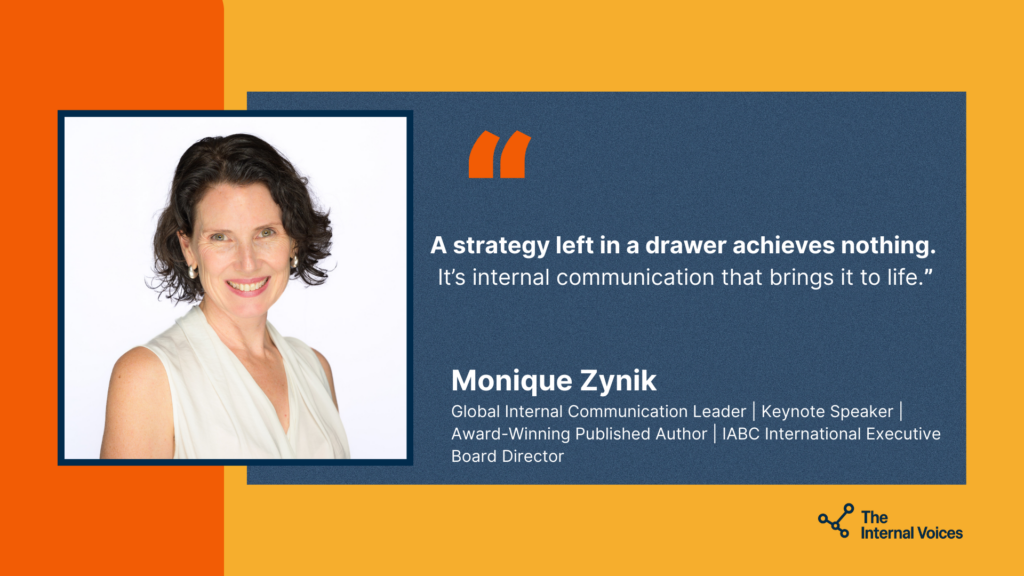
“A strategy left in a drawer achieves nothing. It’s internal communication that brings it to life.”
AI as a forcing function, not a shortcut
Artificial Intelligence enters the conversation not as a threat, but as a mirror.
The real question, Monique argues, is not where to plug AI into existing processes. It is whether Internal Communication is willing to rethink its purpose.
“The conversation needs to be: what is our purpose? What do we want to be? What new processes do we want to put in place?”
She describes teams that used AI not to automate writing, but to design entirely new ways of working. Executive dashboards that translate employee data into formats leaders actually use. Message testing through personas. Translation at scale.
AI, in this sense, does not make Internal Communication more tactical. It forces it to become more strategic.
Because once content becomes cheap, experience becomes everything.
The uncomfortable future of the profession
When asked about the future, Monique doesn’t list trends. She talks about identity.
“I think we need to do a whole rebrand for our profession.”
Internal Communication is still widely perceived as the staff newsletter or the CEO post. That perception will not change through better tools. It will change when the profession claims its role as organisational sense-maker.
One of the most provocative ideas she shares comes from her own, unpublished research: the strategic use of ambiguity. There are moments where being deliberately open, even unclear, can surface reactions, fears and readiness before a change is formally announced.
Clarity, in that sense, is not speed. It is timing.
What remains when everything else is stripped away
If Internal Communication disappeared tomorrow, the loss would not be another channel. It would be the loss of coherence.
The organisation would still speak. But it would no longer hear itself.
And that may be the clearest articulation of the role Monique Zytnik has spent her career defending.
Internal Communication not as output, but as a whole system.
Like blood pumping through the body, it circulates meaning, keeps different parts connected, and sustains life even under pressure.
Not as support, but as a leadership capability.
The quiet force that keeps organisations human when pressure pushes them toward noise.