
Bridging the Frontline Gap: Internal Comms for Deskless & Hybrid Workforces
- trinimaturana
- The Voices in English
Índice
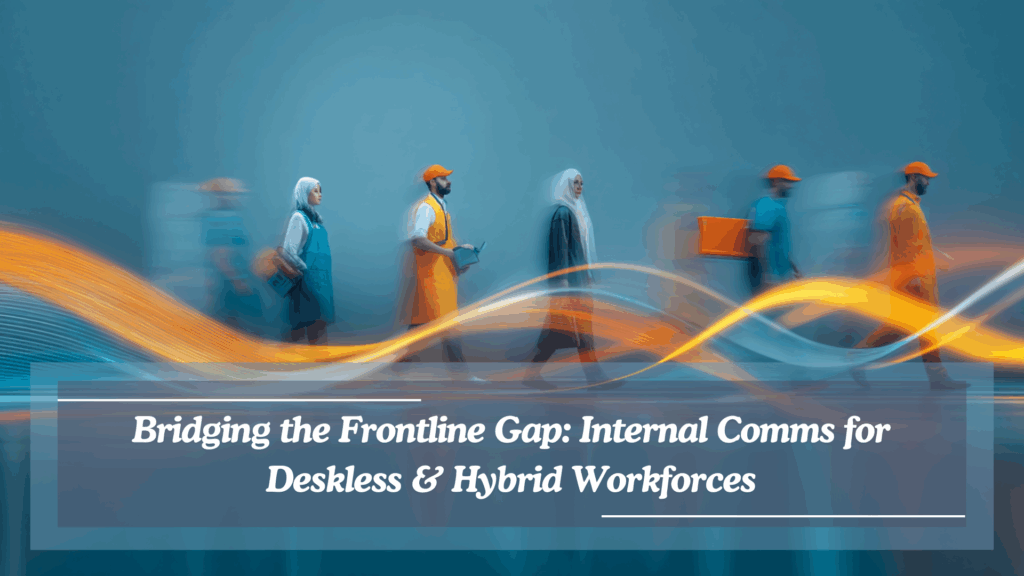
When leaders talk about “employee experience,” the focus often leans toward those working behind screens. Yet, a significant portion of the workforce—retail staff, plant operators, delivery teams, healthcare professionals—rarely sits at a desk. Add to that the complexity of hybrid work, and you get the biggest communication challenge of 2025: how to design internal communication strategies that truly include every employee, not just the ones with easy access to digital channels.
This isn’t just an operational issue. It’s cultural. If frontline and deskless workers feel left out of the company narrative, the sense of belonging, trust, and alignment with purpose suffers. And no engagement survey can cover up that gap.
Why the Frontline Gap Matters
The 2025 Global State of Internal Communications report highlights one recurring pain point: reaching employees without a fixed workspace remains the number one challenge for IC teams worldwide. Frontline employees often:
- Have limited or no access to corporate email or intranet.
- Work in shifts, with little overlap for live updates.
- Depend on managers or peers as the only channel of communication.
The result? Messages arrive late, diluted, or never reach them at all. And when communication fails, so does culture: disconnect grows, trust weakens, and attrition rises.
Designing Communication for the Deskless Reality
Frontline communication needs to start with one principle: meet people where they are. That means shifting from “channels we have” to “channels they actually use.”
Mobile-first platforms.
Internal apps with push notifications, micro-updates, and easy access to shift schedules are becoming the default. Retail companies like Walmart and Starbucks have deployed employee apps that combine communication, training, and recognition in one place.
Visual & short-form content.
Attention spans on the frontline are shorter by necessity. Microvideos, infographics, and 30-second updates work better than long articles. Healthcare organizations increasingly use short video explainers to update protocols on the go.
Physical touchpoints.
Not everything has to be digital. Factories use digital noticeboards and interactive kiosks to make updates visible to all. Logistics companies are experimenting with QR codes posted on site to link directly to mobile updates.
Messaging beyond email.
SMS alerts or integrations with WhatsApp/Teams allow quick reach for urgent updates. It’s about removing barriers, not adding complexity.
Hybrid Work: A Different Kind of Challenge
While deskless workers often suffer from lack of access, hybrid employees deal with the opposite problem: communication overload. They are bombarded with channels, notifications, and meetings—yet still feel disconnected when they miss the “in-person” layer of context.
Internal Comms must design for equity of information: ensuring that what is shared in physical rooms is also captured and made accessible for remote colleagues. Meeting recordings, recap summaries powered by AI, and asynchronous discussion forums are some of the most effective practices.
Metrics That Matter
Reaching frontline and hybrid workers requires new success indicators. Instead of measuring clicks or open rates, forward-thinking organizations track:
- Reach vs. coverage: what % of frontline workers actually saw the message?
- Timeliness: how quickly did critical updates reach distributed teams?
- Manager as channel: how consistent are line managers in reinforcing messages?
- Voice: are frontline employees also sending messages back—sharing feedback, raising issues, contributing ideas?
Case Examples
- Retail: Walmart’s Me@Walmart app allows associates to clock in, check schedules, and receive updates in one place, increasing frontline engagement.
- Healthcare: Mayo Clinic uses short mobile-friendly video updates for quick learning, reducing information gaps across shifts.
- Manufacturing: Siemens has introduced digital noticeboards in plants connected to central IC systems, ensuring critical safety updates are seen instantly.
These cases prove one point: when frontline communication is treated as strategic, it directly impacts retention, safety, and productivity.
The Strategic Role of IC
Bridging the frontline gap is not about adding another tool. It’s about shifting mindset. Internal Communication must:
- Advocate for inclusion of all worker profiles when designing strategies.
- Partner with HR and Operations to integrate comms into daily workflows.
- Use AI and data analytics to anticipate gaps and personalize delivery.
- Ensure culture, purpose, and recognition flow both ways—top-down and peer-to-peer.
Conclusion: Inclusion is Culture
If your communication strategy excludes frontline or hybrid workers, you’re not just missing an audience—you’re fracturing your culture. The future of IC lies in making sure no one is left in the shadows of information.
Because culture isn’t built in town halls or newsletters alone. It’s built when a retail associate, a field engineer, and a remote analyst all feel equally seen, heard, and connected to the same purpose.