
The Work AI Can't Sign: Rachel Miller on Judgement and the Future of Internal Communication
- trinimaturana
- The Voices in English, Voces de la Industria
Índice
One of the world's most influential voices in internal communication on bluster, judgement, and the work that can't be outsourced.
Rachel Miller once asked an artificial intelligence what her cat was called.
She had reason to expect a decent answer. She writes about her cat often and shares photos of it online, so there is a trail for any capable model to follow. She typed the question into ChatGPT and waited. The reply came back quickly, and in confident detail: the cat was called Mrs Whiskerson, and it was hairless.
Both facts were invented. She showed the exchange to her children, twins of eleven and a daughter of fourteen, and asked whether they would have believed it.
“And they said, well, yes, because it’s so detailed.”
That is most of the problem in a single sentence, and it is close to where everything Rachel Miller thinks about her profession right now begins.
She started as a journalist in 1999 and moved into internal communication in 2003, something she still calls a happy accident. Over the two decades since, she has built All Things IC, the consultancy and training practice she founded in 2013, written two books for Kogan Page, and developed the MILLER Framework that many communication teams now work with. What journalism gave her, and what she says she draws on every single day, was discipline: “the rigour and the discipline of verification, checking for accuracy.” The cat is what happens when that rigour goes missing. It was also, in her telling, a lesson she wanted her children to have early.
An extension, not a replacement
None of this makes her a sceptic about the technology. The opposite, if anything. Miller has built her own AI agent, which named itself Atlas, and trained it on the 160,000 words of her two books. She has been working with it daily for six or seven months, and describes it, carefully, as a thinking partner. When she explained it to her fourteen-year-old, she reached for a particular image. “I described it to her as an extension of my brain. It’s not a replacement.”
The distinction is not decorative. It governs how she uses the thing. She sets boundaries with it that sound almost stern when read back.
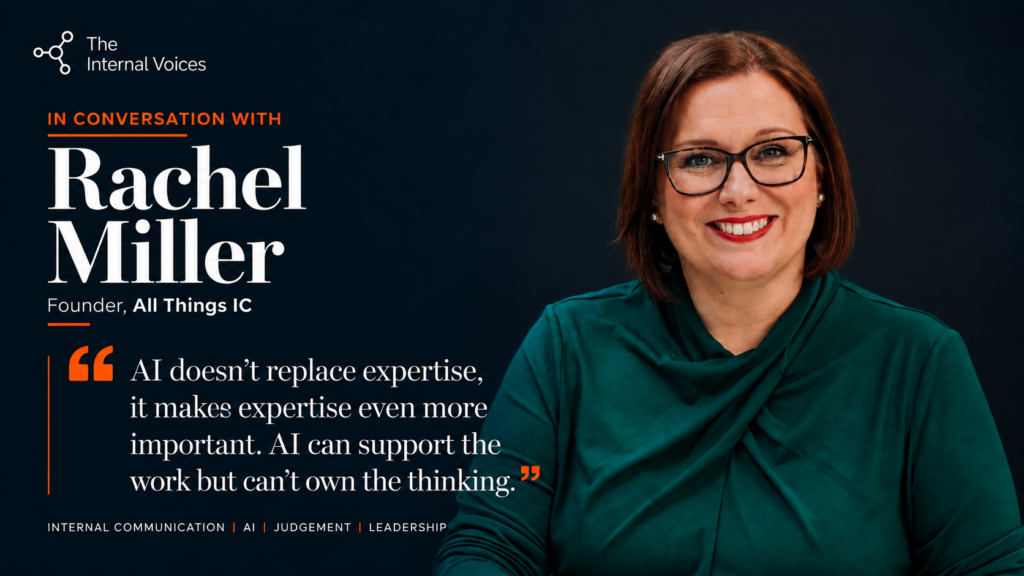
“You don’t know about internal communication. I do. And I don’t need you to be an internal communication expert because I am. AI doesn’t replace expertise, it makes expertise even more important. AI can support the work but can’t own the thinking.”
What she wants from Atlas is not answers but friction of a useful kind. She has told it to spot the gaps in her thinking, to notice patterns, to remind her of things she has already worked through. She has given it a persona, a brand strategist, and an unusually specific brief: imagine we are at a conference, she has told it, I am the one on stage giving the keynote, and you are in the third row with a notebook open, reflecting back what I am doing. She has also, deliberately, taught it to be kind, because she is her own boss and didn’t want another one.
Underneath the experiment sits a line she is clear about, and that matters more as this technology seeps into the work of communication teams everywhere.
“AI is not replacing my thoughts. If you are hiring me… you’re getting me, you’re getting my thoughts.”
The bluster
Miller has a word for the moment the cat appeared, and it is not hallucination. She calls it bluster, and she has written about it on her blog, likening it to the tale of the emperor’s new clothes. “It’s the bluster that comes… where you get a response, and it feels so believable, so probable, and you feel convinced.”
She tested the idea on Atlas itself. She fed it a client brief she found genuinely ambiguous, one she could not tell whether it was asking for a single workshop run twice or two different sessions for two different groups, and watched what the model did with the uncertainty.
“It just gave one version of the truth. It didn’t give me options.”
So she taught it. She went back and, in her words, explained to it how humans infer from language, how we misunderstand and interpret and hold two readings at once. It is a small story, but it carries the weight of her larger worry, the one she shares with anyone teaching people new to the craft. The danger is not that the machine is wrong. The danger is that it is wrong beautifully, and that a reader without the instinct to check will take detail for truth. If it looks too good to be true, she says, it probably is.
Go up a level
Ask Miller what internal communicators are still avoiding, and the answer arrives in one word. “Measurement.”
She thinks the topic has been inflated into something more frightening than it needs to be, when the shorthand is simple: measure what you treasure. The trouble is that when she asks teams what they treasure, they often cannot say. What she sees instead, report after report, is a record of effort rather than effect.
“It’s very much output driven. It’s not outcomes, which I describe as the so what.” Output is easy to count, which is exactly the trap, because a function that only ever counts its output will never be read as strategic. She is blunt about how that looks from the outside. “No other department would get away with that.”
The way out, in her telling, is to stop talking about communication and start talking about the business the communication is for, and she says it to teams so often she hears herself repeating it. “Go up a level. Don’t just talk about channels. Go up a level. Talk about strategy. Go up a level again. Talk about business strategy. Go up again. Talk about impact and reputation.” It would be easy to file that under strategy and move on, a separate subject from anything to do with AI. Miller does not let it sit apart. The thing measurement is meant to prove is the same thing she refuses to hand to a machine, the thinking behind the doing, and when she describes the skill the next years will ask of communicators, the two finally close together.
“learning to hone your judgment and couple it with evidence, with measurement.” Judgement, in her account, is not an instinct to be trusted blindly. It is something to be evidenced. Which is where the machine, and the cat, come back in.
For all her openness to the technology, Miller keeps returning to a category of work she will not hand over, and she is precise about why. It is not sentiment. It is signature.
“I would never want anyone to think we can replace or ghostwrite or outsource leadership communication… We need to see the humanity. We need to see the rawness. We need to see the emotions.”
She has watched what that rawness does, and where it comes from. Some of the work she loves most happens in the wings, in the half hour before a leader walks out to a town hall, when that leader is falling apart backstage, bracing for questions they have not seen and cannot rehearse, and she is beside them getting them ready. Then they walk out, and to communicate some hard change they say to their people: this is really tough, I am in it with you.
“You can’t beat that really raw human emotion. That’s something that AI will never replace.” What an audience connects with, she insists, was never the polish.
“The emotion is what we connect with, not polished and perfect and brilliant prose.” Which brings her to the skill she thinks the next generation of communicators most needs, and it is the same one that named her cat wrongly and got believed. Judgement. She wants it ring-fenced and protected. And she has published a model to insist on where the human belongs in the process, against the industry’s more comfortable phrase.
“We talk a lot about humans in the loop. I published a model which is humans at the beginning, middle and end because we need to put our names to it.”
The name is the point, and not only the communicator’s name. Miller has always insisted that communication was never the property of one team, that it belongs to everyone who speaks inside an organisation. It is her standing answer to the profession’s oldest anxiety, the one about whether it has earned a seat at the table.
“Internal communication is in our job titles, but it’s in their job descriptions.” Rachel believes communication teams should be evaluated according to organisational performance, capability and value creation.
Whose name is on it
So as AI drafts more of the words that go out under a leader’s signature, or a communicator’s, the act of putting your name to something stops being a formality and becomes the whole test. “We have done the verification. We have done the judgment. We feel confident to put our name to it. That as a skill is something that we’ve always done, but it’s now even more important.” It is worth noticing what she has done over the course of a single conversation. She has argued, with equal conviction, that ignoring this technology is not an option, that history is littered with organisations who refused to evolve and no longer exist, and that the most important thing a communicator owns cannot be delegated to it. Both are true at once. The extension of her brain sits open on the laptop beside her, and the judgement about what it produces stays hers. Perhaps that is the question the profession is actually being asked, underneath all the noise about tools and productivity and speed. Not whether the work can be produced faster, because it plainly can. But when the message finally goes out, whose name is on it, and did they do the work to earn the right to sign.