
Why the Best Communication Isn’t Always Another Message
- trinimaturana
- The Voices in English, Voces de la Industria
Índice
There is a request that has followed Internal Communication across two decades of professional evolution.
It arrives in different forms. Sometimes it is a message, sometimes a call, sometimes a brief that lands without context or prior conversation. But the underlying assumption is always the same.
Can you send this out?
Katy Hetherington has heard versions of it throughout a communications career spanning more than twenty years, from Melbourne to London to Stockholm, where she is now Head of Internal and Change Communication at SAS. She has worked across media relations, employee engagement, and organisational change, and joined the airline midway through a major transformation, making it a particularly interesting environment in which to support leaders and colleagues.
The profession, in her telling, has changed considerably since she started. The request has not.
“I think internal communications has changed from being a post box, which not a lot of teams want to be known for now, and rightfully so. We’re moving from being the sender to a strategic advisor, but I still think there’s more work to be done to help our stakeholders understand how communication can add value earlier in the process. And that’s on us to have these conversations.”
That gap, between what Internal Communication has become and what organisations still expect of it, is where our conversation kept returning. And it is where Katy’s perspective becomes most interesting, because she does not approach it as a complaint about organisational immaturity. She approaches it as a practical problem with a practical answer.
The answer is not always another communication.
The moment before anything gets sent
When that familiar request arrives, Katy does not begin with the channel.
She begins with questions.
What is the key message? What do you want people to know, feel and do? What is the outcome? And perhaps the most important one, the one that sounds obvious until you consider how rarely it is actually asked: who is the audience?
“The audience isn’t everyone.”
That last observation does a great deal of work. The default audience for internal communication in many organisations is everyone, a choice that is rarely a choice at all but rather the absence of one. Katy’s response to that default is to interrupt it, consistently and early, before anything has been written or designed or distributed.
“By asking those questions consistently, you already get a better outcome. You have a clearer understanding of really what is this communication truly about? Is it an email? Is it an article? Is it something on the screen? Or is it something else? It could be that you just need to go and talk to that team directly.”
That last possibility is where the strategic contribution becomes tangible. A profession historically organised around producing communication has to become comfortable with the possibility that sometimes the best intervention is not another piece of communication at all. Sometimes the answer is a conversation. And the communicator’s value in that moment lies precisely in the judgement to know the difference.
Katy has watched that shift play out across very different organisations. The teams and the tools have changed many times over, and so have expectations of the function. As communication becomes more strategic, deciding what deserves communication, and what does not, has become an increasingly important part of the work.
Saying yes to everything stops being possible, and the choice of what actually deserves a communication, and what does not, quietly becomes the strategic work itself.
The channel the organisation keeps underusing
Once the conversation moves away from distribution, the question of channels becomes more interesting. And more honest.
At SAS, that question is genuinely complex. Office colleagues can be reached through articles, email, town halls and screens. Pilots, cabin crew, ground staff and operational teams consume information in very different contexts, often away from a desk and through different channels. Katy is a few months into reviewing that ecosystem and is careful not to claim she has already solved it.
But she is clear about where the greatest opportunity lies. And it does not appear on any digital platform map.
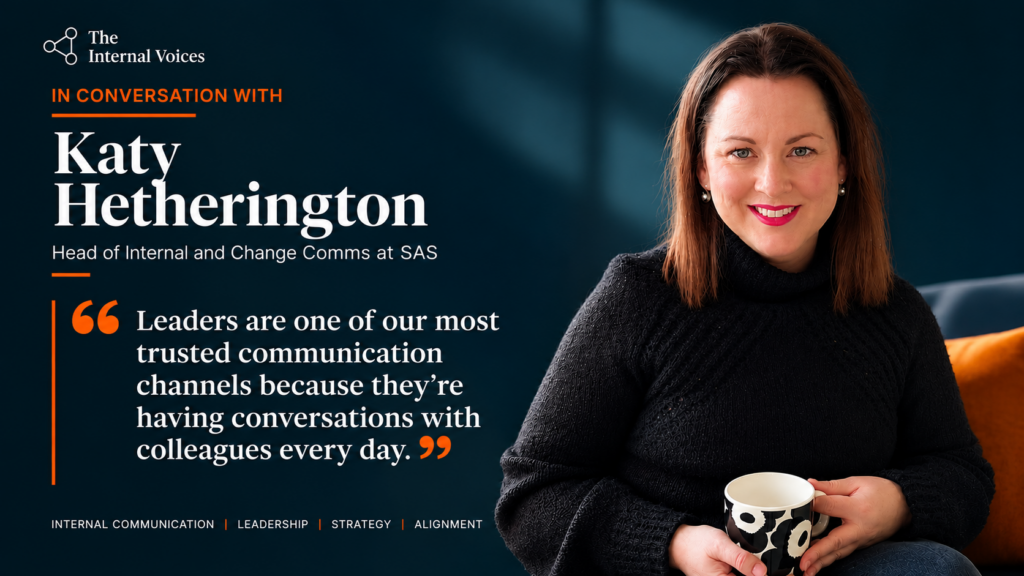
“Leaders are one of our most trusted communication channels because they’re having conversations with colleagues every day.”
The significance of that idea becomes clearer when you stop thinking about leaders as a distribution layer. Their role is not to cascade corporate messages downward. It is to make those messages meaningful within the reality of a particular team, in a particular location, doing a particular kind of work.
“The main thing is helping leaders understand the strategy and why it matters, then helping them translate it for their team.”
Translation is doing a great deal of work in that sentence. A corporate strategy can be perfectly legible at executive level and still mean almost nothing to someone working at an airport gate, managing a flight crew or handling ground operations. The leader sits close enough to that reality to connect the two. Internal Communication becomes responsible for something more complex than producing talking points. It helps create the conditions in which leaders understand enough of the business to have useful conversations about it with their teams.
Katy has spent significant time doing exactly that in previous organisations, building leadership understanding of strategy before expecting leaders to take it forward. At SAS, she sees considerable potential in developing that capability further.
“For many organisations, leaders are one of the most trusted sources of information for colleagues, yet they aren’t always supported in that role.”
Leaders have significant reach and credibility, as well as the ability to turn information into meaning for their teams. Yet despite that, leaders are not always developed and supported as communicators to the extent they could be.
What leaders actually need in uncertainty
That investment becomes most critical when the organisation does not have all the answers. SAS operates in an industry shaped by geopolitical events, fuel economics, operational pressures and external disruption that can change the context quickly. More broadly, organisations everywhere are asking leaders to communicate through transformation while the destination itself may still be moving.
The traditional instinct is to wait for certainty before communicating. Katy’s approach is almost the opposite.
“Leaders aren’t really expected to always know everything. They’re expected to reduce unnecessary uncertainty.”
The distinction matters more than it might appear to. Reducing uncertainty does not require manufacturing certainty. It requires being precise about what is known, equally precise about what remains unresolved, and dependable about what happens next.
“The most powerful communication is just saying, look, this is what we know today, and here’s what we don’t know yet. And this is when you hear from us again. So really having a clear way forward, even if you don’t have all the answers.”
There is a discipline in that kind of communication that is easy to underestimate. It asks leaders to resist filling gaps with reassurance they cannot substantiate. It asks Internal Communication to help them create enough structure that people are not left to fill those gaps themselves, with rumour, with anxiety, or with silence.
At SAS, iCare provides a shared set of values for how colleagues work together. For Katy, what matters is how those values show up in everyday behaviour.
“You don’t always need to label a behaviour as a value. If people see consistent examples of it in action, they’ll make the connection themselves.”
Culture, in this framing, is not simply communicated. It is reinforced through everyday behaviours, including the conversations leaders have with their teams.
What AI is freeing communicators to do
There is a practical dimension to this conversation as well. Supporting communication across an operation as complex as an airline means constantly deciding where the hours go, and AI, in Katy’s experience, has changed that calculation in specific and useful ways.
She uses it to analyse town hall chat feeds, identifying key themes, categorising questions and producing summaries for leadership in the time that previously would have required hours of manual review. She is experimenting with prompt-driven workflows that turn interview transcripts into article drafts, compressing a process that once took days into something much shorter. She uses it for rapid synthesis of large documents when she needs to absorb information quickly.
“I’ve got more time to speak with stakeholders and build relationships. I think that’s a huge part of our job, is carving out the time to do that. AI can’t get those conversations for you. You as a person have to go out and meet people in order to understand how we can better support the business.”
The efficiency AI creates is not valuable in itself. It is valuable because of what it makes possible: stronger stakeholder relationships, a deeper understanding of the business, and more time spent supporting leaders as they prepare for the conversations their teams need them to have.
Those conversations are where communicators create the greatest value as advisers to the business.
What the profession is actually for
Near the end of our conversation, I asked Katy how she would define Internal Communication after more than twenty years working across the profession.
“It’s about helping people understand where we’re going as a business, why it matters and the role they play in helping us get there.”
There are no channels in that definition. There is no mention of articles, platforms, newsletters or screens. There is understanding, purpose, business direction and the connection between what an organisation is trying to achieve and the role people play in making that possible.
Perhaps that is why the postbox metaphor still carries weight.
The problem it described was never simply that communicators were producing emails and newsletters. Those things remain part of the work, and sometimes they are exactly what an organisation needs. The challenge was the assumption that sat underneath them: that communication entered the process once somebody else had already decided what needed to be said, to whom, and why.
A strategic adviser enters earlier. They ask what problem needs to be solved. They challenge the assumption that everyone needs the same thing. They decide whether another message will create clarity or more noise. And they support their leaders, helping them turn information into understanding, and business direction into something that makes sense in the day-to-day reality of their teams.