
Sara Miller: AI Adoption Doesn't Need a New Mindset. It Needs a New Mindstate.
- trinimaturana
- The Voices in English, Voces de la Industria
Índice
Some conversations stay with you not for what was said, but for how it reframes everything you thought you knew. My conversation with Sara Miller was one of those.
Sara spent the past six years leading a communications team at Amazon Web Services (AWS), where she built and managed a global team through one of the most consequential periods. She has spent her career in the space most Comms leaders live in: senior enough to sit in the room where strategy gets shaped, hands-on enough to see exactly where it breaks down on the way out the door. A few months ago, she left AWS to start SB Miller Comms, a consultancy focused on helping communications leaders move beyond AI experimentation and into something she calls an AI-First Mindstate.
That distinction, between mindset and AI-First Mindstate, is where our conversation began. And it is where everything else she said eventually returned.
The word that changes everything
Most conversations about AI adoption in communications orbit around mindset. Leaders need the right mindset. Teams need to shift their mindset. The word appears so frequently that it has lost almost all weight.
Sara uses a different term deliberately.
Mindset, in her framing, describes what you think. It is the intellectual acknowledgement that AI matters, that it is changing the profession, that you should probably be paying more attention to it. Most communicators, she argues, are already there. They know AI matters. The problem is that knowing something and integrating it into your daily behaviour are two completely different things.
AI-First Mindstate is the behaviour change. It is the moment when reaching for AI at the start of a project, using it to stress-test a message before it goes out, or speaking into the microphone to brainstorm with it on a Monday morning becomes as natural as opening your inbox. It is not about enthusiasm or conviction. It is about habit architecture.
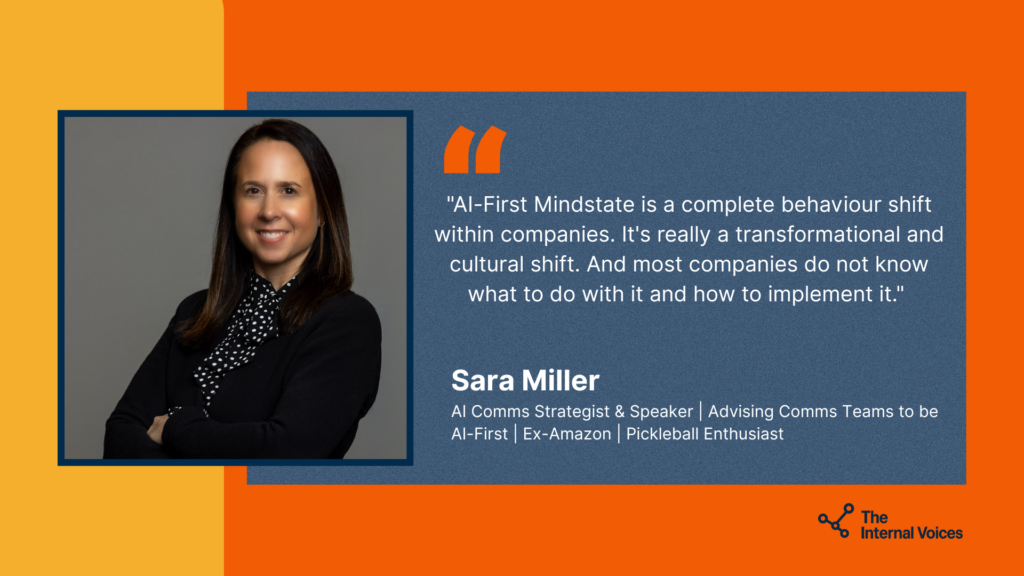
“AI-First Mindstate is a complete behaviour shift within companies,” she told me. “It’s really a transformational and cultural shift. And most companies do not know what to do with it and how to implement it.”
The distinction lands with force because it explains something that data on AI adoption keeps confirming: the gap between organisations that have invested in tools and organisations that are seeing measurable value is not primarily a technology gap. It is a behaviour gap.
What she learned at Amazon
When Amazon’s CEO asked Amazonians to bring AI into their daily work, the instruction arrived without a roadmap. The mandate was clear. The path was not.
Her first instinct was not to find the best AI tool. It was to define the problems and business challenges worth solving.
She ran what she calls “Think Big” brainstorming exercises with her team: structured sessions designed to surface the specific business challenges the team was facing. Only after naming those problems did the question of where AI could help become answerable. The approach kept the team from the trap she now sees from her clients: people who fall in love with features and functionality before they understand their use case.
“It wasn’t about the LLM,” she said. “It was about the business problems our team was trying to solve to achieve our strategic priorities.”
From there, the work became more concrete. Which tasks were consuming time without requiring genuine judgement? Where was the team spending hours on requests that AI could handle in minutes, freeing communicators to do the work only they could do? The answer pointed toward what she calls low-judgment tasks: brand guidelines, templated responses, knowledge management, the kind of work that is tactical but necessary strategic.
What she built at Amazon was not an AI programme. It was a shift in how the team understood its own value and transition their time spent on tactical execution to more strategic work for their stakeholders.
The 40% that still belongs to us
There is a version of the AI conversation in communications that creates anxiety. If AI can draft faster, structure more coherently, and adapt tone on demand, what is left for the communicator?
Sara’s answer to that question is precise, and it is what she now teaches in every workshop she runs.
AI, in her experience, gets to about 60% if it’s done right and the upfront work is put in. It produces a draft that is structurally sound, contextually relevant, and often surprisingly good. But the remaining 40% is not a small thing. It is the part that determines whether communication works.
That 40% is sense-making. It is the emotional intelligence to know if a message is technically accurate will still land wrong with this particular audience at this particular moment. It is the relationship context that no prompt can fully encode. It is the brand voice that lives in the communicator’s instinct, not in a style guide.
“You are the gatekeeper of the final context,” she said. “AI is good, but it’s better when it’s used as our thought partner tool.”
The risk she sees most consistently is not that AI is poor. It is that communicators accept the 60% as finished and send it. They remove themselves from the loop at precisely the moment when their presence matters most. The output looks adequate. It is also, in ways that are difficult to pinpoint until the message fails, wrong.
The AI-First Mindstate she advocates for is one in which the communicator never confuses faster with complete. Speed is real. It creates space. But that space should be filled with better judgement, not with fewer reviews.
Where most implementations quietly fail
If the AI-FirstMindstate is the destination, change management is the road. And it is, in Sara’s observation, the road that most organisations have decided not to build.
The pattern she describes is remarkably consistent across many of her clients. Technology teams select a tool. IT rolls it out. Communications is asked to write an announcement. Leadership declares the organisation AI-enabled. Adoption stalls. ROI is nowhere to be found.
What is missing is not enthusiasm. It is effective change management.
“Change is not going to happen on its own,” she told me. “It requires very thoughtful change management and implementation strategies.”
In her experience, the organisations that achieve genuine adoption share a few structural features. Leaders work out loud, sharing not just their conviction that AI matters but their personal experience using it. There are designated AI champions across the business who serve as connective tissue between teams, sharing what is working, surfacing what is not, and keeping the narrative coherent. Stories of success are actively gathered and told, rather than left to circulate informally or not at all.
When none of that infrastructure exists, the vacuum fills with something else. Shadow AI: employees using personal devices and unapproved tools, routing confidential information into public platforms without understanding the risk. Siloed experimentation: multiple teams solving the same problems independently, duplicating effort, arriving at different conclusions. Brand voice fragmentation: AI outputs that carry no common thread because no shared framework was ever built.
“Nobody’s closing the gap,” she said. “And we need to have strong AI champions and leader-led models, working in partnership with Comms teams, to see real transformation and change across businesses.”
The governance conversation, in this framing, is not a compliance exercise. It is the structural equivalent of the AI-First Mindstate shift. You cannot ask individuals to change their behaviour without building the environment that makes the new behaviour possible, visible, and coordinated.
The question of ROI
2026 has shifted the conversation in a direction Sara saw coming.
Last year, organisations were asking their employees whether they were experimenting with AI. This year, they are asking what the return on that experimentation has been. The tools have been purchased. The subscriptions are running. Leadership wants to know what they bought.
Most communications teams, she argues, are unprepared to answer that question, not because the value is not there, but because they never measured the baseline.
Her advice is almost aggressively practical: stop waiting for something transformational to measure. Baseline now. Record how long specific tasks take today. Note the quality of outputs before AI assistance. Then measure again at thirty, sixty, and ninety days. Build a scorecard that speaks in language leadership understands: time saved, quality improved, strategic capacity freed.
“If you’re not identifying KPIs and not measuring hours saved, time saved, quality of content, you’re not uncovering the ROI,” she told me.
The AI-First Mindstate, in this sense, has an economic dimension. Teams that have integrated AI as behaviour, not just as tool access, can demonstrate the delta. Teams that are still at the level of occasional experimentation cannot.
What comes next
Toward the end of our conversation, Sara described a future that communicators are already beginning to encounter in glimpses.
The job of the future, in her reading, is less about building communications from scratch and more about managing and monitoring the agents that build them. Workflows that are currently assembled manually will be automated. The communicator’s role will increasingly involve monitoring those workflows, auditing their inputs and outputs, and making the judgement calls that determine when automated becomes inadequate.
That evolution requires skills that are not new to communications, but that are now more explicitly central to it: the ability to think across disciplines, to collaborate with technical functions, to understand what makes a prompt intentional rather than generic. And above all, the capacity to hold the interpretive function that no agent will ever replicate: understanding what a message means for this organisation, this team, this moment.
“Our jobs may not just be about building,” she said. “It’s about monitoring and managing agents into the future.”
What will distinguish communicators in that environment is not their familiarity with any particular tool. It is whether they have made the shift she has spent the last eighteen months describing, teaching, and building a consultancy around.
Not just knowing that AI matters.
Having changed their behaviour because of it.
SB Miller Comms helps Communications teams move from AI experimentation to measurable strategic impact, using a practitioner-built methodology designed for the realities of enterprise Comms work. Founded by Sara Miller, a 20+ year Communications leader with AI adoption experience at Amazon Web Services, the firm delivers AI strategy sessions, hands-on workshops, implementation strategy and support, and advisory services grounded in the AI-First Mindstate, where AI becomes a natural part of how Comms teams operate every day. Learn more at www.sbmillercomms.com.