
Mette Krogh: When Communication Stops Behaving Like a Function
- trinimaturana
- The Voices in English, Voces de la Industria
Índice
The illusion of order
Copenhagen has a way of making organisational life look deceptively calm.
The language is measured. Hierarchies feel lighter. Trust is often described as infrastructure rather than aspiration. From the outside, it is easy to assume that communication inside these environments must somehow be easier, cleaner, less burdened by the control mechanisms that define more traditional corporate cultures.
And yet, sitting across from Mette Krogh in Copenhagen, the conversation moved in a very different direction.
Mette has spent more than twenty-five years advising organisations and leadership teams through communication, change and strategy execution. She has led communication functions inside some of Denmark’s most established companies, including Ramboll, and now works independently at the intersection of leadership, organisational transformation and behavioural change. She no longer speaks about communication as a publishing discipline. She speaks about it as something much closer to organisational movement.
Perhaps that is exactly why one idea kept surfacing throughout our conversation: communication has become harder to control because organisations themselves no longer behave in controllable ways.
That may sound obvious. It should still make many communication teams uncomfortable.
Much of the discipline was built around the assumption that communication could be shaped, packaged and distributed with a reasonable degree of predictability. Leadership defined the message. Communication translated it. Managers cascaded it. Employees received it.
For years, that model gave organisations a reassuring sense of order.
Mette has watched that logic become increasingly irrelevant.
Leadership in a live system
One of the most revealing moments in our conversation came when she described what leadership communication now demands from managers.
“Leaders are much more expected today to facilitate dialogues across the organization upwards, sideways, to colleagues, to other teams and particularly downwards… ensuring the feedback loop.”
That is a fundamentally different leadership role.
The leader is no longer simply responsible for transmitting strategic information with consistency. Today, leadership communication requires the ability to create dialogue, absorb uncertainty, interpret ambiguity and help teams make sense of change while the change is still unfolding.
That sounds strategically mature. It is also operationally exhausting.
As Mette put it, “quite many leaders feel overwhelmed, uncomfortable by that role. Leaders are extremely busy people.”
That discomfort matters.
Because while leadership roles have evolved, many organisational communication models still behave as if information moves in neat sequences.
It doesn’t.
By the time leadership speaks, the organisation is already talking
One of the most revealing parts of our conversation emerged when we talked about speed. Internal communication once moved at the pace of hierarchy. Information was packaged, approved, distributed and translated through management layers. Today, information behaves differently.
It circulates before formal communication ever begins.
Mette captured that shift with striking clarity:
“Quite often strategic messages coming from the top leadership has gone to employees before it has been cascaded to them from their leaders.”
Anyone working in internal communication will recognise that moment instantly.
The organisation is already having the conversation while leadership is still preparing to announce it.
That changes the nature of the discipline itself.
If communication is already happening everywhere — in informal conversations, in hybrid environments, through social platforms, across peer networks — then the communication function cannot continue defining itself through control.
Communication begins to look far less like distribution and much more like orchestration.
Mette herself used a striking metaphor to describe this shift. Communication, she explained, behaves more like a living organism than a controlled mechanism. Something that must be kept alive, responsive and coherent rather than tightly managed from what she jokingly referred to as “the ivory tower.”
The advisory shift
That shift changes the profession.
And, frankly, it should.
For years, communicators built expertise around creating content, managing channels and shaping internal narratives. Those capabilities still matter. They simply no longer define the strategic centre of the role.
Mette is very clear about what comes next.
“Being an advisor today is basically to have a much more holistic compass… where you both think about communications tools, leadership tools, strategic tools and cultural behavioral tools.”
That sentence says a great deal about where the profession is heading.
The communication advisor she describes is not an internal content manager with stronger stakeholder skills. It is someone operating much closer to leadership judgment.
Timing becomes strategic. Context becomes strategic. Understanding what employees are experiencing becomes strategic. Anticipating how a message collides with competing organisational realities becomes strategic.
Trust does not reduce complexity
And perhaps this is where the Nordic context becomes particularly interesting.
If trust is genuinely embedded in organisational culture, leadership communication should theoretically have a stronger foundation. Dialogue should feel more natural. Feedback loops should be less forced. Employees should be more accustomed to transparency and more willing to challenge leadership constructively.
To some extent, that appears true.
But trust does not reduce complexity.
If anything, it increases the expectation that leaders will show up as present, responsive and human.
That became particularly clear when I asked Mette what leaders are doing better today than they were fifteen years ago.
Her answer was not about communication frameworks or strategic messaging.
It was authenticity.
“Leaders have begun to actually bring in their own personality much more and make their way of delivering key messages much more personal.”
That observation stayed with me.
As communication becomes faster, noisier and structurally harder to control, what employees seem to value most is not polish. It is presence.
AI will accelerate the divide
At the same time, expectations on communication professionals are shifting dramatically, particularly as artificial intelligence accelerates the commoditisation of execution work.
One of the things I appreciated most about Mette’s perspective is her pragmatism around AI. There is neither hype nor defensiveness in her view. Just clarity about what is changing.
Years ago, a communication team might be asked to interview an employee, shape a story and produce an internal feature for the employee magazine. Today, much of that work can be done differently.
As she put it:
“today that is covered by AI.”
The implication is not that communicators become less relevant. It is that the nature of relevance is shifting.
As execution becomes easier to automate, the centre of gravity moves elsewhere — toward judgment, timing, contextual awareness and the kind of organisational reading that cannot be delegated to a tool.
That creates a strategic fork in the road.
Communication teams can continue defining themselves through outputs that increasingly become operational commodities. Or they can move toward the role Mette describes: trusted advisors helping leadership teams navigate complexity, culture and organisational behaviour.
Culture is what employees actually experience
One of the strongest moments in our conversation came when we moved into strategy.
I asked Mette how organisations should think about strategy in a world where priorities shift constantly, where business realities change faster than traditional planning cycles, and where certainty feels increasingly temporary.
Her answer was immediate.
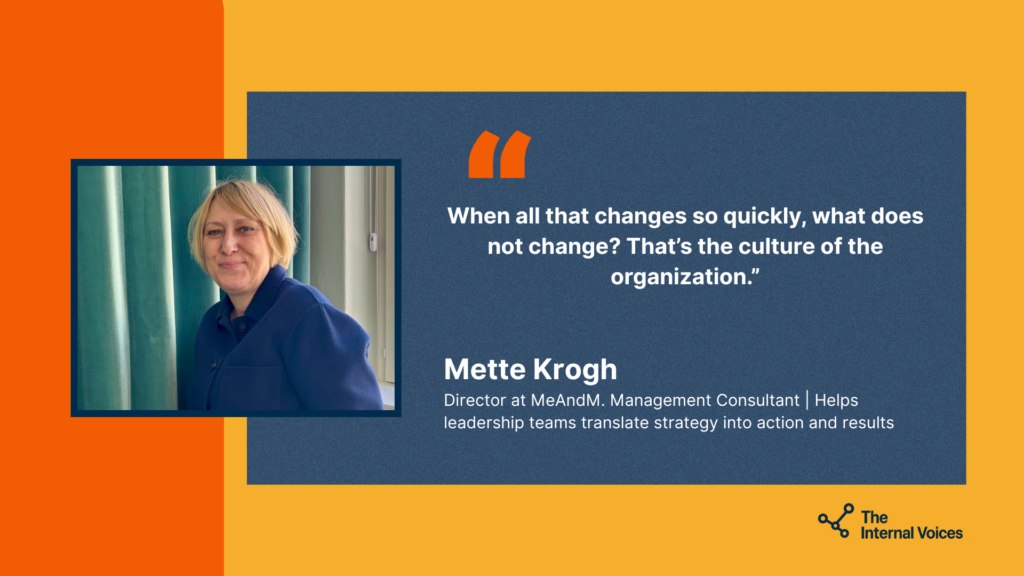
“When all that changes so quickly, what does not change? That’s the culture of the organization.”
It is a deceptively simple observation.
Strategies evolve. Priorities move. Structures reorganise. Leadership teams change.
Employees rarely experience strategy in its abstract form. What they experience instead is culture — through leadership behaviour, through recognition systems, through decisions, through what gets rewarded, tolerated or challenged.
That is where communication becomes deeply strategic.
Not because it distributes messages more effectively, but because it helps organisations create coherence between what they say, what leaders do and what employees actually experience.
Closing
And perhaps that is the deeper shift underneath everything Mette described.
Internal communication did not lose control.
It lost the illusion that organisations were ever truly controllable in the first place.
The organisations that adapt fastest will understand that communication was never about perfect distribution.
It was always about helping people make sense of movement.