
Ellen Summey: “If I can’t understand it, I can’t write about it”
- trinimaturana
- The Voices in English, Voces de la Industria
Índice
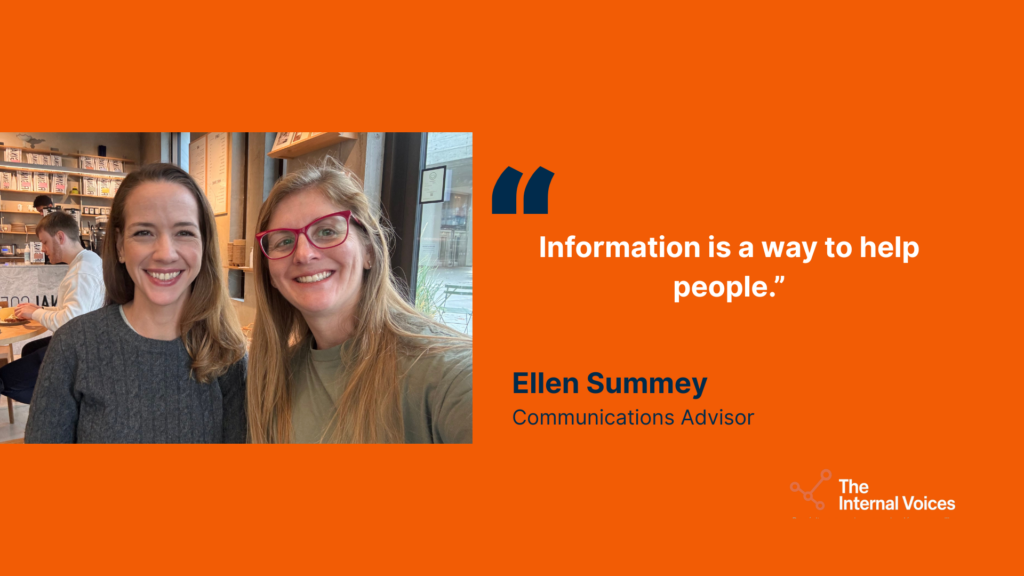
My first in-person interview for The Internal Voices, from the heart of Copenhagen.
Most interviews for The Internal Voices happened through screens. This one didn’t.
For the first time, I sat across from a guest —two women, two coffees, and a conversation that flowed with the ease of two communicators who have lived through many of the same contradictions.
Ellen Summey is not just a communicator. She is a translator of complexity. A professional who has worked inside the U.S. federal government, navigated different cultures, and now supports communication strategy for DHIS2, an open-source data platform that is the world’s largest health management information system a clarification she insisted on making to give proper credit to the team behind it, rather than implying she “leads” it.
“It has to be very short, very important, to the point.”
Our conversation was grounded, generous, and above all, honest.
From TV News to Global Strategic Communication
Ellen’s career began where many of ours did: in journalism.
She studied mass communication and worked in student-run TV, fascinated by the discipline of clarity.
After graduation, she became a morning show producer and digital writer but life kept moving her across states, time zones, and countries. Through this mobility, she found her path into strategic communication:
“I think it’s been fun. It’s not a career path that I would have planned… but it complemented what I had learned about communication.”
It’s a path many communicators recognize: journalism was the doorway; strategy became the home.
Public vs. Private vs. Scandinavia: Culture Shapes Communication
Ellen worked inside the U.S. federal government, one of the most structured communication environments imaginable:
“Everything has a very rigid structure… there is a very clear path to have your messages approved before you release them.”
Her shift to Scandinavia revealed an entirely different approach not in terms of message structure, but in organizational hierarchy and decision-making:
“Things are more consensus-based and there is less control. There’s more trust.”
The distinction is essential: There is still rigor, planning, and process but fewer external constraints and a far flatter hierarchy than in other countries she has worked in.
Communicating Complexity: DHIS2 and the Weight of Understanding
Ellen now works with the HISP Centre at the University of Oslo (UiO), which develops and maintains the open-source DHIS2 software, a certified digital public good that began more than 30 years ago as a research collaboration between UiO and the University of the Western Cape in South Africa.
DHIS2 is now used worldwide:
“It is now the world’s largest… it’s used in more than 100 countries.”
Her audiences include donors, ministries of health, IT implementers, researchers, and internal teams.The work is deeply technical and that’s precisely why communicators must step up:
“If you are communicating about any topic… the key is that you first have to understand it.”
Then she delivered the sentence that defines her entire philosophy:
“If I can’t understand it, I can’t write about it.”
Clarity begins with humility with the willingness to ask the questions others don’t.
Ellen reinforced this idea through advice she once received from a brilliant editor:
“What I bring to this is my ignorance.”
Not ignorance as incompetence, but as a strategic advantage.Through asking foundational questions and seeking deeper understanding, communicators learn to clarify the complex.
Outcomes, Data, and Letting Evidence Speak
Ellen’s approach to leadership stakeholders is quietly powerful:
“I’m not going to be the one who says, ‘Oh, but you’re doing this wrong.’ I’m just going to show them.”
As she explained, communicators are trained to “communicate,” but sometimes the most effective strategy is to let results speak for themselves, a principle she summarized as: don’t talk about it, be about it.
And the evidence flows through data:
“If you can show the data, people will listen.”
But never vanity metrics:
“You have to show the outcomes. What was the result? How did that change?”
For Ellen, strategic communication is an ongoing cycle:
“You research, you plan, you implement, you evaluate and then you start over again.”
Storytelling, Purpose, and the First Rule of Communication
When the conversation turned to storytelling, Ellen grounded it in utility:
“Information is a way to help people.”
And with characteristic candor, she added:
“My first rule of communication is that people don’t read. Not even my own mother cares enough to read everything that I write, and we can’t assume that our audiences will, either.”
Her framework is simple: Who needs this information, and why would they care?
On Silos and the Politics of Ownership
Discussing the tension between HR, Marketing, and Communications, Ellen named it plainly:
“We shouldn’t get bogged down in this sort of office politics about who owns what or who’s in charge of what…”
And then offered a metaphor that stayed with me:
“We are all like branches of the same tree.”
Silos erase conversations that shape culture. Ellen counters this by intentionally listening in on meetings across the organization:
“You learn about what their goals are… and that’s helpful for us when we’re planning communication.”
AI: Embrace It, But Don’t Worship It
Ellen’s approach to AI is pragmatic:
“I have done my best to embrace AI tools because I think they improve my work.”
But she refuses blind trust:
“It still requires a lot of editing… it will make things up.”
She uses AI to summarize research, accelerate analysis, and structure thinking:
“What used to take months… it can do that pretty effectively.”
Yet she remains clear about its limitations:
“I don’t think it’s great at writing yet.”
And the danger of fabrication is real:
“It will completely make up quotes… ‘Oh, I just invented that.’”
AI is a tool and communicators must remain the adults in the room.
Advice for the Next Generation of Communicators
Ellen’s guidance to emerging professionals is both realistic and hopeful:
“There will always be a need for communication… what changes is just how we’re communicating, and on which channels.”
But she adds an essential safeguard:
“We also have to protect our audiences. If you’re just sharing everything that comes across your desk, you’re not doing a good job.”
And offers a roadmap worth printing:
“Learn about project management. Learn about business… learn about data. If we only are writers, we can’t be business communicators.”
Closing: A First Interview, a Global Lens, and a New Beginning
This wasn’t just an interview. It was the first in-person conversation for The Internal Voices, held in Copenhagen, a symbolic moment for a project built to connect perspectives across borders.
Ellen embodies the communicator of the future: curious, precise, culturally aware, data-literate, and deeply human.
Her most powerful line remains:
“Information is intended to help people.”
A simple philosophy. A perfect beginning for the next chapter of The Internal Voices.