
Better, Not Faster: Natalia Edde on the Judgement AI Can't Scale
- trinimaturana
- The Voices in English, Voces de la Industria
Índice
Every conversation about AI and communication tends to begin in the same place: speed. How much faster a team can work, how much more it can produce, how quickly a blank page becomes a campaign. It is the promise printed on every tool.
Natalia Edde has sat through enough of those conversations to be suspicious of the promise. When we spoke, she kept returning to something that runs against the grain of almost everything the industry is currently celebrating.
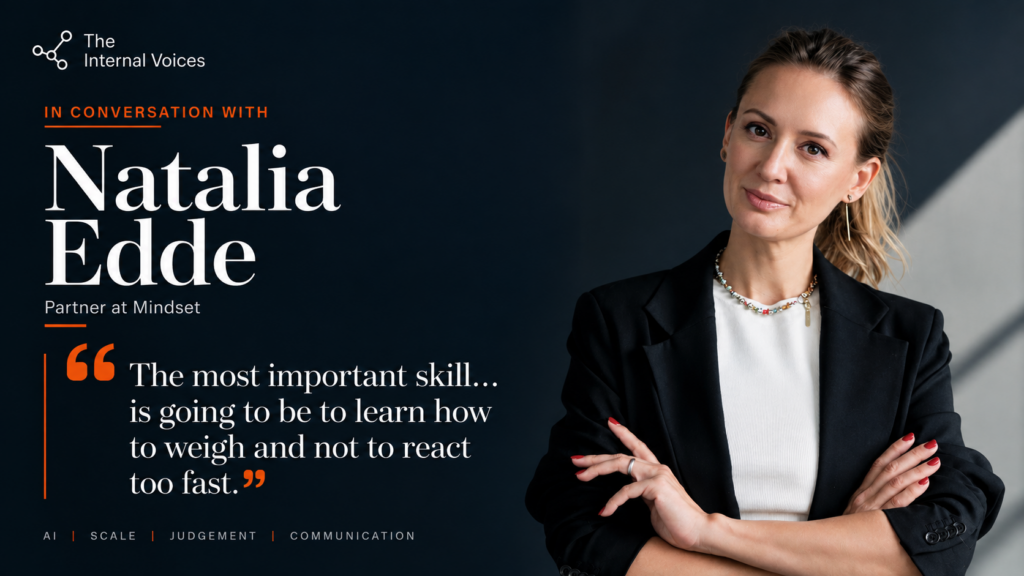
“The most important skill… is going to be to learn how to weigh and not to react too fast.”
Not to produce faster. To wait. To weigh. To resist the reflex that speed makes so tempting.
Coming from someone whose career has been spent moving brands quickly through crowded markets, the observation lands with some authority. Natalia has more than twenty years in marketing and communication behind her, from regional marketing for the largest retail chain in the CIS region to nearly a decade in premium FMCG, where she launched brands for Remy Cointreau and managed a substantial marketing budget at Carlsberg Group. Today she is Partner at Mindset, a Madrid-based marketing and communications agency working with tech companies, venture funds and founders across the US, UK, Europe, the Middle East and Latin America, and named PR Agency of the Year in 2024. Her clients, in her own framing, are companies scaling worldwide. Which means she has watched, many times over, what actually happens to communication when it grows.
What breaks before AI arrives
Scale was difficult long before anyone had a model to blame it on.
Natalia describes a pattern she sees again and again with founders. In the beginning there is total clarity. The founder knows the company, the values, the story, and holds all of it in one head. It works like a small family. Then the family grows, new people arrive, and each of them starts to carry the story a little differently.
“The same message already has a different meaning.”
The company finds itself positioned in ways nobody quite decided. Consistency, holding one message across markets and departments, becomes the first casualty of growth. Large corporations face the mirror image of the problem: so rigid that nothing moves without headquarters, so careful that they cannot react at the speed a moment demands.
And then there is the problem that has nothing to do with company size. The communication function, Natalia notes, tends to sit third on an executive’s list of priorities, behind strategy and operations, right up until the morning a request for a quote goes unanswered because it landed on a Friday evening after the team had gone home. She has watched clients arrive already in crisis, only to trace the disaster back to a single message nobody returned in time. By the next day, the damage was done.
None of that was caused by AI. It is the terrain AI arrives into.
The junior intern
Natalia is, by her own description, a sceptic. Not a refusenik. Her agency uses AI every day, and she actively encourages her managers to reach for anything that saves them hours. The question for her is never whether to use it. It is where the human has to stay in the room.
“You have to treat AI… like a junior intern that is doing some tasks for you, but you still need the professional experience team to control and to double check everything that was produced by AI.”
A junior intern is genuinely useful. A junior intern is also unfinished. It produces, quickly and tirelessly, but it cannot yet be trusted to decide. In her experience AI is strong at the things that sit close to pattern and volume: summarising a meeting, analysing a data set that already exists, generating the first angle for a pitch, producing visuals at a speed her designers could never match alone.
What she is careful to say is that none of this has simply made her teams faster. It has added a layer of work that did not exist before. Now someone has to check what the model produced, check what the transcription missed, check which sentences came from a person and which from a machine. Some clients are anxious enough about AI-generated content that her agency now runs detectors on its own team’s work before anything reaches them. The tools multiplied. So did the hours spent verifying them. She is honest that she is still not sure the efficiency is real.
The intern will never have the thing she spent two decades building.
“What does AI certainly not have is my opinion based on the gut feeling, based on all the talks with journalists, based on all the experience.”
The things that do not translate
If some of communication scales cleanly, some of it does not scale at all.
“Localisation doesn’t mean translation.”
You cannot run a press release through ChatGPT and send the same story into every market. Natalia works across regions that reward completely different instincts. In the Middle East, a request that ignores the religious calendar, or strays anywhere near local politics, or addresses the royal family without the right formality, can quietly end a relationship before it starts. In Mexico, an editor who never opens their email will answer a WhatsApp message, but only after a conversation about the weekend and the family. In the US you skip the pleasantries entirely and go straight to the point. The same pitch, the same words, cannot possibly do all of that at once.
Her sharpest example is a story that inverts as it crosses an ocean. A campaign about giving small businesses access to short-term loans reads as empowerment in Europe. In parts of Latin America, where small businesses are often drowning in exactly that kind of debt, the same story reads as something closer to cruelty. A local professional catches it. A model does not.
“AI will tell you, wow, it’s a great angle, you know, because AI is always very supportive.”
That single line holds most of the argument. A model will approve almost anything you bring to it. It is built to be encouraging. The person who knows what a micro-loan means on the ground in Mexico is the one who will stop you, and that is precisely the judgement that no amount of fluency reproduces.
Taught by the machine
The part of the conversation that stayed with me longest was not about tools at all. It was about the people entering the profession now.
Natalia described meeting a young specialist who could set up outreach to a thousand journalists and write the prompts to find every one of them, but could not say what a given company actually did, or what a Bloomberg journalist would ever care about. Enormous reach, almost no depth. The campaign scaled. The understanding underneath it never got built.
“They believe that AI is the final book that they have to follow.”
She is careful here, and this is what makes the point serious rather than nostalgic. She does not think the younger generation is worse. In many ways they are faster and more fluent than she is, more native to the technology, better at the prompt than she will ever be. Her worry is narrower and harder to dismiss: that people who learn the craft from AI never build the critical thinking she built the slow way, from books, from peers, from practice, and from being allowed to make her own mistakes. The answer arrives too cleanly now. There is less reason to think, and so, sometimes, less thinking.
Better, not faster
Which returns us to where the conversation began.
The real question AI puts to communication is not how much more we can make. It is whether we can resist making more simply because we finally can. Natalia sees clients caught in the contradiction from both sides at once. They expect the speed AI promises, and at the same time a growing number of them do not want AI anywhere near the work. Some now write it into the contract: no AI used to produce content for this client. Brands like Dove have said publicly they will keep it out of their campaigns. The audience, it turns out, can feel the difference, and increasingly wants to know when a machine did the writing.
So the advantage of a great communicator, in a world where producing communication is almost frictionless, is not production. It is the judgement to know what deserves to exist, which angle will land and which will wound, when to send and when to wait.
AI increases the pace of the work; “the human capabilities of the brain are the same.” The machine got faster. We did not.
Natalia is not certain how the balance settles, and she does not pretend to be. There is no way back, she says, the way there was no way back from the internet, but the technology will find some ceiling, and we will learn to use it as help rather than replacement. When we finished, she suggested we do this again in five years and see where we all stand.
It seemed like the only honest place to leave it.