
Kristina Siraeva: Where Leadership Communication Actually Happens
- trinimaturana
- The Voices in English, Uncategorized, Voces de la Industria
Índice
There is a moment in every organisation where communication stops being something you design and starts being something people either feel or don’t.
That moment rarely sits in a campaign, a channel or a perfectly structured message. It happens somewhere much closer to people. In how leaders show up. In how they speak. In whether what they say connects with what employees are actually experiencing. That tension shaped my conversation with Kristina Siraeva.
Kristina’s career has moved across very different organisational and cultural contexts. From large European corporations to startup environments in the Middle East, and also into the Nordic model in Denmark. Different industries, different paces, different expectations of leadership. And yet, one constant keeps appearing. Communication follows leadership or it collapses around it.
At one point in the conversation, she put it in a way that leaves very little space for interpretation.
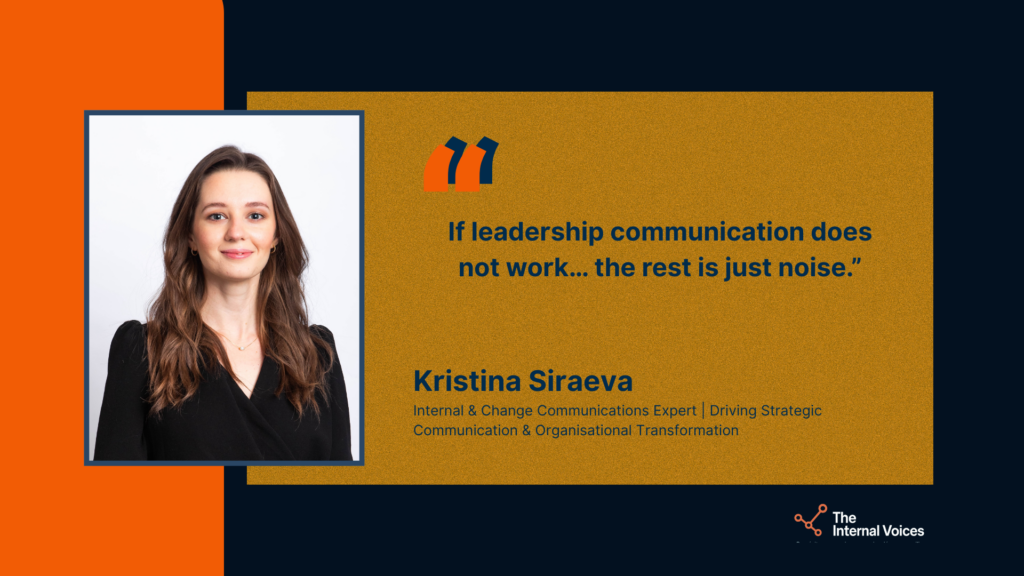
“I cannot imagine a working effective communication at a workplace without the good leadership communication. No matter how good, up-to-date, and modern your tools are, or how engaging your content formats are, if leadership communication does not work and your employees ultimately do not feel connected to the leaders, the rest is just noise.”
There is something uncomfortable in that idea. Because it shifts the center of gravity. The quality of internal communication does not sit in the tools, the formats or even the content itself. It sits in the relationship employees have with leadership. Everything else builds on top of that.
What employees are actually looking for
When we talk about leadership communication, it is easy to stay at the level of messaging. Clarity, consistency, alignment. The usual language.
Kristina brings it somewhere more direct.
“Every employee wants to receive clear communication from their leaders, and to feel a connection to them, because connection means trust. Sometimes what a leader actually says matters more than the values or mission written on the wall.”
There is a shift there that many organisations still underestimate: values can be written and strategy can be defined. What employees read is something else entirely.
“Leaders’ actions say more about the culture in a company than the values written on the intranet or posters in the office.”
In practice, culture becomes visible through behaviour. Through tone. Through presence. Through absence. Communication does not sit on top of that. It moves inside it.
The distance between intention and reality
One of the most precise moments in the conversation comes when Kristina describes how leadership messages are actually built. There is always a starting point. What the leader wants to say. What needs to be communicated. What must be delivered. But something else is happening at the same time.
“It’s very important that communication is drafted not from the point of view of the leader, but from the point of view of the audience. What a leader wants to say can be very different from what the audience needs to hear right now.”
That distance is where most communication loses its impact. Leaders operate with context, information and intent. Employees operate with partial visibility, uncertainty and emotion. When those two worlds don’t meet, even well-crafted messages fall flat.
Kristina describes the work of communication in a way that feels much closer to interpretation than production.
“Before we write anything, we build a picture of the audience for the leader: where they are right now, what they do not yet know, how they feel. Are they frustrated? Are they lost? Are they facing a challenge the leader may not be aware of? A leader who walks in with that picture sounds completely different from one who doesn’t.”
Understanding that gap is what allows communication to land.
Leadership is experienced locally
As the conversation moved forward, another layer became visible. Organisations tend to speak about leadership as if it were one voice. One direction. One narrative.
Employees experience it differently.
“It’s very important not to look at all leaders as one group. The role of someone in the executive suite and the role of a team leader are quite different, because the closer you are to people, the higher the impact you have.”
That proximity changes everything. It is often not the CEO who defines how change is perceived. It is the team leader. The person who translates, filters, reinforces or questions what is coming from above.
Kristina has seen how direct that relationship can be.
“I have seen a clear positive correlation between how engaged a team leader is in a change and how their team responds to it. If the team leader is engaged, their team is usually more receptive to that change. But if the leader expresses doubts, the team follows.”
There is no campaign that compensates for that.
When leadership becomes human
One of the most revealing moments in the conversation comes through a story. A company was under significant pressure when leadership asked already tired and frustrated employees to go the extra mile. The first attempt to bring people along leaned on HR language, legal framing, and generic motivational messages from the executive team. It made things worse. Then one manager chose a different approach entirely.
“This particular manager never hid behind legal language or high-level corporate messaging. They showed up as a human being, were not afraid to show vulnerability, and spoke to people not as their boss but as someone who was also responsible for delivering on the promises the company had made, and who needed the team’s help to do that.”
The reaction changed with it.
“The mood shifted almost immediately from defensive and resistant to ‘of course we will help you, we are in this together.’ What made the difference was not a better communicated strategy or a more polished message. It was honesty and the courage to be human in a tough moment.”
There is a clarity in that moment. Employees do not respond only to direction. They respond to something much more basic. Whether they feel addressed as part of the same reality.
AI will enter this space carefully
When we moved the conversation into artificial intelligence, the tone changed. There is openness. Curiosity. Recognition of the possibilities.
And also caution.
“AI can do a lot in this space. We could even train it to act as a communication coach for leaders. But it is a very delicate area.”
The reason sits exactly where leadership communication becomes most sensitive.
“Most employees say leadership communication has to be honest. They prefer conversational over scripted. And they need leaders to be in touch with what they are experiencing.”
The space where AI operates efficiently is the same space where employees are looking for authenticity.
Kristina captures the tension in a simple way.
“An honest, unpolished message will land far better than the most perfectly structured one, especially when it comes to leadership communication.”
There is no shortcut there.
Where communication really operates
Towards the end of the conversation, Kristina returns to something that sounds almost obvious.
“Know your audience. Where are they right now? What do they know? What kind of language speaks to them?”
It sounds simple. It rarely is. Because knowing the audience at that level requires something more than data. It requires proximity. Listening. Interpretation.
“We have the ability to gather feedback, understand where things landed clearly and where there are gaps, and bring that back to leaders, so that whatever their message is, it reaches people in the right context.”
That is where internal communication actually operates. Not in the message itself. In the space between what leaders intend and what employees experience.
Closing
Leadership communication is often treated as a skill. In practice, it behaves more like a condition.
It shapes whether people understand where the organisation is going. Whether they feel part of it. Whether they move with it. Everything else builds around that, and in that space, communication does something very specific.
It makes sense of what is happening. Before anything else can move.